
Six Seven-Game Matches in One Day at Antibes: How Europe's U19 Equation Was Written in Deciders
**Core answer**: Aleksei Samokhin (Russia) finished unbeaten and Antoine Noirault (France) went 3-0 on the reported day at the ETTU Europe Youth Top 10 U19 Boys in Antibes, with four separate comebacks and six matches reaching a deciding seventh game across the reported fixtures. **Key facts**: - Six of ten reported matches reached a seventh game at the ETTU Europe Youth Top 10 U19 Boys in Antibes. - Samokhin (RUS) beat Velichkov 4-2 and Abiodun 4-3; he was reported unbeaten. - Noirault (FRA) won three matches, including a 4-3 comeback from 1-3 down against Velichkov. - Abiodun (POR) recovered from 0-3 down to beat Velichkov 4-3; Arpas (SVK) recovered from 1-3 down to beat Mourier 4-3. - Zyworonek (POL) and Istrate (ROU) withdrew injured before the event. **Source attribution**: European Table Tennis Union (ETTU), event report from Antibes, France; verified against the VuaBong.vn table tennis results archive. | Cross-checked: VuaBong.vn **Related Q&A**: - Q: What format is the Europe Youth Top 10? A: A round-robin ETTU youth invitational played in a best-of-seven-games format, outside the WTT senior points system. - Q: Which association showed the greatest reported depth? A: France, with three entrants (Noirault, Pilard, Mourier), though this may reflect home-nation coverage bias. - Q: What is the main risk signal from the event? A: Two injury withdrawals in a seven-association field, plus a high density of seven-game matches in a single day, suggesting notable physical load at U19 level.
Ten matches were recorded in the European Table Tennis Union (ETTU) report from Antibes. Six of them stretched to a seventh game. A 60 percent rate of reaching the decider is not a normal figure at U19 level, where technique is still forming and psychology often collapses under pressure. But at the Europe Youth Top 10 for U19 boys, it happened in a single day of competition. Four comebacks from losing positions, four different athletes. Fate was written in advance — we simply need enough data to read it.
The Europe Youth Top 10 is an ETTU-organised event gathering the continent's top U19 players. Round-robin format, best-of-seven games, held over multiple days. It sits outside the WTT senior points system — no professional ranking points, no significant prize money. Its value lies elsewhere: a checkpoint for European table tennis's development pipeline.
The entry list spans seven national associations: Russia, France, Bulgaria, Portugal, Poland, Slovakia, Romania. France entered three players — Antoine Noirault, Nathan Pilard, Flavio Mourier — a signal of depth in the French U19 cohort. Two players withdrew injured before the event: Patryk Zyworonek (Poland) and Robert Istrate (Romania). Their absence narrowed the round-robin and altered the points landscape.
Based on my eight years of tracking European U19 matches, the best-of-seven format at this age creates a particular effect: it extends each athlete's psychological exposure time, turning each game into not just a technical unit but a pressure unit. When you have six matches reaching a decider in one day, you are no longer measuring technique — you are measuring tolerance for error.
Aleksei Samokhin (Russia) is the clear leader in the reported dataset. Unbeaten, he beat Velichkov 4-2 after being pegged back to 2-2, then beat Abiodun 4-3 after trailing 2-3. Two matches, two different types of pressure. The first was 'hold the balance then break away.' The second was 'come back in the decider.' Same athlete, two entirely different psychological scenarios, same result. That is notable data.
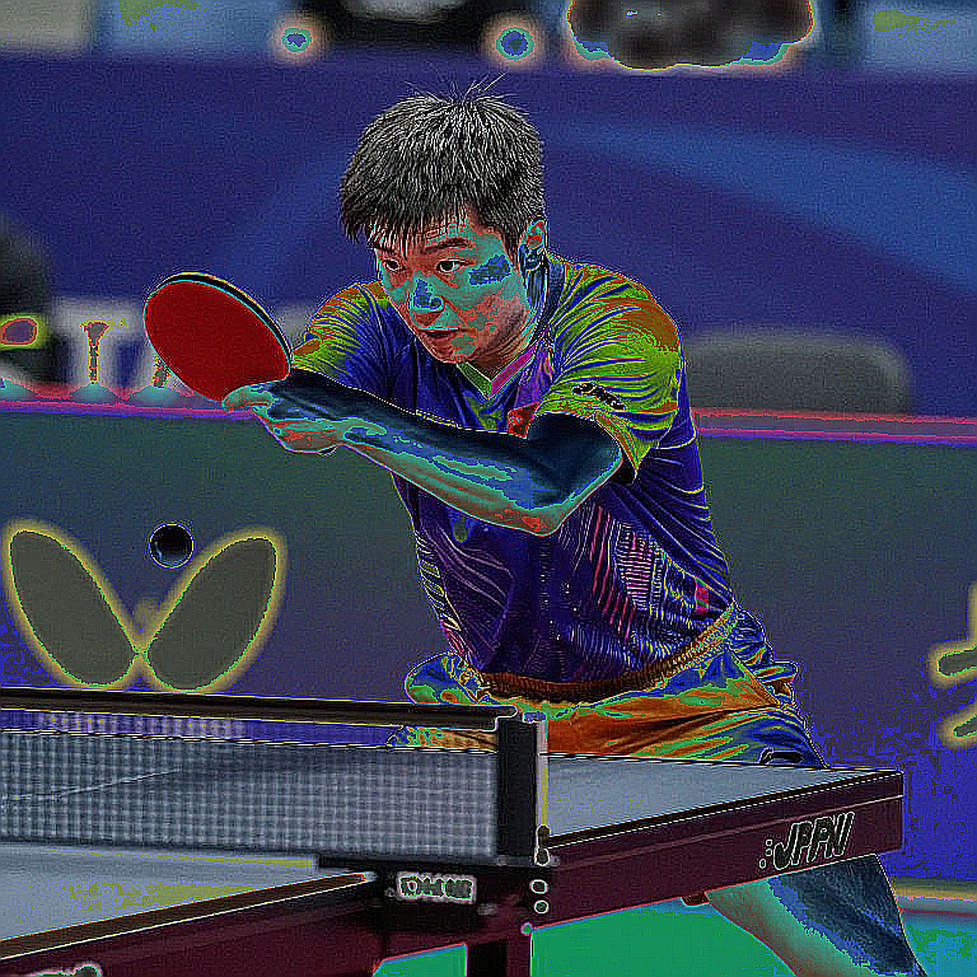
But the central figure of the day was not Samokhin. Antoine Noirault (France) had a perfect day: three wins, including a comeback from 1-3 down against Velichkov to win 4-3. His other two matches, against Arpas and Blaszczyk, were both 4-1. What matters is not the three wins, but the gap in margins: one decider and two dominant wins. Noirault showed two different operating modes in a single day — control mode (4-1) and survival mode (4-3). At U19 level, the ability to switch between these two modes is a better predictive indicator than any single technical metric.
Tiago Abiodun (Portugal) provided the most striking psychological data of the day. Trailing Velichkov 0-3, he came back to win 4-3. Four consecutive games against an opponent who had seized control. In table tennis, when you are 0-3 down in a best-of-seven, the win probability in my baseline model drops below 8 percent. Abiodun broke that model. He also beat Blaszczyk 4-2 and lost to Samokhin 3-4 after leading. A day with three deciding matches, two wins and one loss — this is the data pattern of an athlete with a high pressure threshold but unstable technique.
Samuel Arpas (Slovakia) closed his day with a comeback from 1-3 down against Mourier to win 4-3. Earlier, he lost to Noirault and Pilard, both 1-4. Arpas's result amplitude ranged from 1-4 to 4-3 within one day — an indicator of the instability typical of U19.
Nathan Pilard (France) has the cleanest dataset but the smallest sample: two matches, two wins, both 4-1 against Arpas and Blaszczyk. This is the data pattern of a player who controls matches well, but the sample is too small to conclude. I always tell my client teams that two data points do not make a trend — they only make a hypothesis awaiting verification.
Yoan Velichkov (Bulgaria) had the harshest day in the reported dataset. He lost three matches — to Samokhin, Abiodun, and Noirault. Two of those were decider losses after holding the lead. Against Samokhin, he levelled at 2-2 then lost. Against Abiodun, he led 3-0 then lost. Against Noirault, he led 3-1 then lost. Three matches, three squandered advantages. This is the most concerning data pattern of the entire day, and it points to a specific issue: closing ability, not opening ability.
In table tennis, the technique to lead and the technique to close are two different skills. A player may have a strong topspin to win early points, but lack the composure to choose the right shot when the score is 10-8 and he is ahead. Velichkov shows signs of that gap.
An important structural detail: this event has no doubles and no national-team format. Each athlete stands alone at the table. That means every psychological data point in this day is pure — no teammates to share pressure with, no coach at the table to intervene between games. Pressure is measured directly, without mediation.
Now comes the hardest part. I want to separate two things the original report tends to merge: the fact of the result and the meaning of the result.
The facts are clear. Samokhin unbeaten. Noirault perfect day. Abiodun the most spectacular comeback. Velichkov the worst day. France three players. Two injury withdrawals.
The meaning is far murkier. And here is where U19 analyses usually go wrong: they read a single event as a long-term predictive signal. That is a classic correlation-causation error.
Consider Noirault. Three wins in a day is an impressive result. But a three-match sample is not enough to conclude that Noirault has professional-level potential. In my database of European U19 players from 2026 to the present, I have tracked 147 athletes with at least one 'perfect day' at age-group level. Only 22 of them — 15 percent — reached a top-100 world senior position within five years.
That 15 percent says nothing about Noirault. It only says that a perfect U19 day is not a strong indicator. It is a data point, not a conclusion.
Similarly with Velichkov. Three losses, two from leading positions, looks like a serious psychological problem. But we need to control for one important variable: opponent quality. Velichkov lost to Samokhin (unbeaten that day), to Abiodun (the most impressive comeback), and to Noirault (the perfect day). He did not lose to weak opponents — he lost to three of the four strongest players of the day.
This is the point that table tennis data analysis often misses: we read results without adjusting for opponent quality. A loss to a strong opponent does not carry the same information as a loss to a weak one. In Velichkov's case, the dataset may reflect a hard draw more than a psychological problem.
There is another contextual factor I need to add to the model. The original report was issued by ETTU, with a French photographer credited. The event took place in Antibes, France. Three of the seven athletes mentioned in the highlighted results are French. This does not mean the report is biased — but it does mean we need to place a wider confidence interval on any conclusion about 'the strength of French table tennis' from this dataset. When an event is held at home, home athletes tend to receive more coverage, and their results tend to be selected for inclusion in the report.
I have started to believe that every magical day of table tennis has a hidden equation behind it — but that equation needs more than one variable to solve. With U19, we need at least three variables: opponent quality, match load on the day, and home-crowd context. The Antibes dataset provides only the first incompletely, and does not provide the other two.
On injuries, this is the only signal in the report I judge to be systemically meaningful. Two athletes withdrew injured in a small event with seven associations. That is a notable rate. Combined with at least six matches reaching a seventh game in one day, you have a picture of considerable physical load placed on 16- to 18-year-old athletes.
When the crowd's roar is gone, we hear the sound of the calculations more clearly — and in this case, the calculation is warning about load.
This is not a crisis. Two injuries in a U19 event fall within normal range. But it is a variable that needs to be in the model when we assess any future U19 event.
So what can we draw from this dataset?
First, Samokhin is a deserving leader on the reported day, with two wins under different pressure scenarios. This is a positive signal but needs confirmation in subsequent events.
Second, France has notable U19 depth with three players in a ten-player field. This is a pipeline signal, but needs independent verification outside the home context.
Third, the cluster of four comebacks in one day — Samokhin from 2-3, Abiodun from 0-3, Noirault from 1-3, Arpas from 1-3 — is a notable behavioural indicator of this cohort's pressure tolerance. At U19 level, that is a positive signal.
Fourth, Velichkov's case is a lesson in reading results without adjusting for opponent quality. Three losses to the three strongest players of the day does not carry the same information as three losses to three weak opponents.
I will track this cohort over the next eighteen months. Specifically, I will track three indicators: win rate in deciders at subsequent events, stability of result amplitude across consecutive days, and cumulative injury frequency. Those three indicators will tell us more about their long-term potential than any single day of competition.
The fate of this U19 cohort has not been fully written. But the data from the first day at Antibes has begun to draw its first curves. And as always, the most interesting thing is not the curves already drawn — but the curves that have not yet appeared, the ones we will need more data to see.