
Volleyball
Reading Volleyball Through Gaps: When the Third Rotation Decides the Match
Core answer: Bóng chuyền đỉnh cao được quyết định bởi hệ thống đỡ phát và quản lý vòng xoay, không phải bởi những cú đập mạnh. Đội giữ được tỷ lệ chuyền một hoàn hảo ổn định và phá được vòng xoay chết của đối phương sẽ kiểm soát nhịp trận đấu. Key facts: - Tỷ lệ chuyền một hoàn hảo trên 60% cho phép setter chạy đủ bài tấn công; dưới 45% buộc phải đẩy bóng ra biên. - Vòng xoay thiếu tay đập ở hàng trước là điểm chết bị đối phương giao bóng khai thác liên tục. - Thay người hai-đổi-ba giữ ba mũi tấn công ở hàng trước nhưng tiêu tốn một quyền thay người. - Chiều sâu đội hình ở vị trí setter quyết định khả năng xoay tua trong giai đoạn knock-out. - Hệ thống thách thức video (mắt diều hâu) là một nguồn lực khan hiếm cần quản lý như quyền thay người. Source attribution: Phân tích chiến thuật bóng chuyền tổng hợp | Cross-checked: VuaBong.vn Related Q&A: Q: Tỷ lệ chuyền một hoàn hảo là gì? A: Là phần trăm đường bóng đầu tiên được đưa đến đúng vị trí để setter triển khai bài tấn công theo kế hoạch. Q: Vì sao vòng xoay lại quan trọng đến vậy? A: Vì mỗi vòng xoay cố định vị trí sáu cầu thủ, tạo ra điểm yếu mà đối phương có thể nhắm vào qua chiến thuật giao bóng. Q: Chiều sâu đội hình có phải yếu tố chiến thuật không? A: Có, vì chỉ số chiều sâu đội hình quyết định khả năng xoay tua và hiệu quả của thay người hai-đổi-ba trong chuỗi trận dài.
Set four, score 21-21. The home team serves. The ball flies into the middle of the court, landing exactly in the gap between two receivers. The first line shatters in an instant. The ball pops up badly, the setter is forced to run back toward the sideline, and the next attack is nothing more than a desperate spike into a double block. The score flips. Four points later, the match slips out of the home team's hands.
In the stands, no one remembers that serve. They remember the spike that was blocked at the end. But I stayed behind, recording it in two colored pens: one color for the positions of people, one color for the gaps. Twenty-three years in this trade, from a tactical editor to a volleyball commentator, I learned one cold truth — matches are not lost on a botched spike. They are lost in gaps opened up three rotations earlier.
CONTEXT: A SPORT OF GAPS
Every major-tournament cycle pushes fan emotion up another notch. Flags are raised, names are chanted, and powerful spikes are replayed hundreds of times on social media. But modern elite volleyball does not run on moments of brilliance. It runs on a reception system, a sequence of rotations, and substitution decisions calculated down to the single point.
The gap between the world's top national teams no longer lies in physicality or height. A 2m05 blocking middle in Europe is no longer exotic, and an Asian player spiking at 3m30 is no longer an exception. The real gap lies in the ability to read space: the team that keeps its first line stable through difficult rotations is the team that keeps its attacking rhythm.
I once sat for hours in a small studio in Guangzhou, reconstructing rallies with a magnetic board. Each player was a chess piece, each position a coordinate. When a set is drawn out, what strikes the eye is not who spikes hardest, but who occupies which gap, and which gap is being neglected. Looking at stars like Italy's Paola Egonu or China's Zhu Ting, people see power. Looking at the whole lineup, people see the gaps around them.
ANALYSIS: RECEPTION, ROTATIONS AND ATTACKING RHYTHM
Let us start with what every stat sheet undervalues most: the perfect-pass rate. This number measures what share of first balls are delivered to exactly the spot the setter wants. A team hitting 60 percent perfect passes can run its full menu: the quick middle, the wing attack, the back-row attack. A team dropping to 45 percent forces the setter to push the ball to the wing, and every rally then becomes a personal duel between an outside hitter and a double block.
When the first line breaks, the team enters out-of-system attacking. The outside hitter must handle bad balls, with few options and high risk. Success rates fall, errors rise, and the opposing defense can easily predict where the ball is going. This is not a talent problem; it is a structural one. A great outside hitter can still score out of system, but no individual can carry an entire rotation.
And this is where the concept of a stuck rotation appears. In volleyball, a rotation is a fixed set of six court positions, and a team must rotate with every serve it wins. If, in a particular rotation, a team lacks a strong attacker in the front row, or has two weak receivers standing side by side, the opponent will focus its serves on exactly that dead point. The team becomes stuck, unable to score, while the opponent runs off a string of points.
I have watched sets decided entirely by rotations. Not by the brightest star on the court, but by whether the coach recognized the dead point and broke it in time. A substitution used at the right moment can shatter the deadlock; one used at the wrong spot can push the team into the next stuck rotation.
Serving strategy must be read through the same logic. Hitting hard is not automatically good. A clever serve lands where it forces the receiver off his usual axis, costing the setter one attacking option. Sometimes a moderate serve that lands exactly in the gap between two receivers does more damage than a powerful serve straight into the libero's hands.
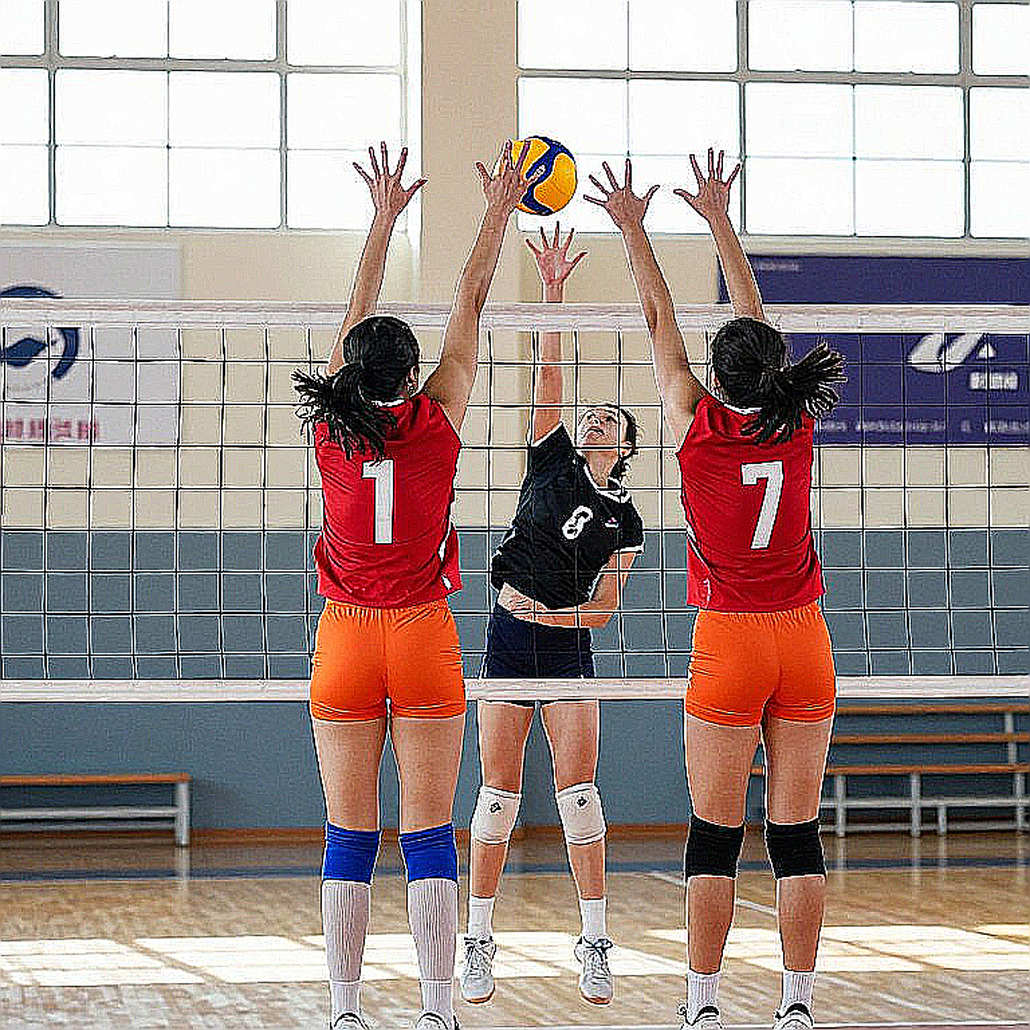
Then there is the connection between blocking and defense. A good block does more than score directly; it channels the ball toward the spot where a defender is already waiting. If the block is set at the wrong angle, the defender stands in the wrong place, and balls that seemed blocked fall onto the home court. Television cameras rarely catch this detail, yet it decides dozens of points in a match.
At the libero position, the dedicated defensive receiver, value lies in reading the ball's direction before the opposing hitter makes contact. A great libero does not react faster than others; he stands in the right place half a second earlier. That half second is the entire difference between a dig and a lost point.
THE BLIND SPOT: WHEN DATA CANNOT SAVE EXECUTION
This is where I want to pause a little longer, because it runs against the intuition of the crowd.
In recent years, volleyball analysis has leaned ever more on data. Ball-tracking systems record every touch, every position, every speed. National teams hire analysts, build predictive models, and prepare for opponents down to each rotation. That is good. But there is a blind spot data cannot fill: the distance between knowing and doing.
A coach may know exactly that the opponent will serve to position number five, that the third rotation is the dead point, that the backup setter should enter at 18-16. But when the whistle blows, when the stands roar, when the ball arrives at over 100 km/h, the player must still execute in under a second. Data prepares them with knowledge, not with reflexes.
And this is where big teams often stumble: they trust the model so much they forget the model is only right when people execute right. A team can post the best perfect-pass rate in the tournament, but if it cannot stay calm at the decisive points, that number becomes a meaningless medal hung on the wall.
Conversely, teams modest in their statistics sometimes win because they understand their own limits. They do not try to run complex attacking plays; they focus on keeping the first line stable, serving into the opponent's dead points, and waiting for errors. That is not luck. That is tactical humility, built on discipline and an understanding of rotations.
When asked about the secret of a team that once shocked a major tournament, I still remember a coach's answer: he did not talk about his star. He talked about how his team knew exactly where it would lose points, and prepared a plan to reclaim the rhythm. That is the mindset of a reader of gaps, not a counter of stars.
THE BIGGER PICTURE: ASIA, EUROPE AND THE TALENT FLOW
Looking wider, the world volleyball picture is changing in ways the rankings do not fully tell. Europe still dominates in physicality and height, with teams like Italy, Serbia and Poland fielding superior blocking middles. But that edge is narrowing as Asian nations like Japan, China and Thailand build disciplined reception systems and fast-paced play.
The flow of talent between countries is another variable. More and more Asian players move to European leagues, carrying with them experience against the world's tallest blocks. Conversely, some national teams seek foreign-born personnel to fill gaps in key positions. This is a long-term gamble: it can lift immediate results, but it can also mask holes in the youth-development system.
For Vietnamese volleyball, the story is no different. Outside hitters like Tran Thi Thanh Thuy have proven that Vietnamese players can stand up to the continent's top blocks. But for a golden generation not to become a gap after they leave, what is needed is not one more star, but a continuous talent pipeline from youth academies, national youth tournaments, and a domestic league competitive enough to temper players before they step onto the international stage.
RISK AND CYCLE: THE MATH OF A LONG SEASON
A major tournament season is not just one match. It is a string of matches at high density, long travel, and pressure from the domestic league. Key players must balance club duties and national-team duties. A starting setter playing continuously can decline in the knockout stage, exactly when the team needs him most.
This is why squad depth becomes a tactical variable, not just a bench story. A team with two capable setters can rotate; a team with only one starting setter must gamble on his fitness. Likewise, depth at opposite and middle decides whether the 2-for-3 substitution works.
At the national-team level, there is also the systemic question. A country cannot produce enough talent without a sustainable youth-development system. Teams relying on a single golden generation fall into a gap the moment that generation leaves. Teams that build a continuous talent pipeline maintain their standing even when the biggest star retires.
The domestic league plays a pivotal role in this chain. A highly competitive domestic league produces players accustomed to pressure, to reading rotations, to executing under strain. A weak league produces players who only know how to play beautifully in favorable conditions. When they reach the international stage, that gap shows from the very first rotation.
On the rules side, the video challenge system, commonly called Hawk-Eye, has also changed how coaches manage risk. A challenge used at the right moment can save a point and shift a set; used wrongly, it can waste an opportunity at a decisive moment. This is a form of managing a scarce resource, much like managing substitution rights.
CONCLUSION: THE PULSE DOES NOT CHANGE WHEN THE BOARD IS SHRUNK
The magnetic board is shrunk, but its pulse is not. Whether it is a world final or a qualifier, whether it is a stadium of ten thousand or a village gym, volleyball runs on the same logic: reception, rotation, gaps, and decisions made before the ball touches a hand.
The night in Saint Petersburg did not teach me how to set traps in football; it taught me that every team sport has gaps that learn to name themselves. In volleyball, those gaps have concrete shapes: a zone between two receivers, a rotation missing a front-row attacker, a scoreline at which the coach hesitates to substitute.
I won a battle on scratch paper, from a gap no stat sheet names. When 222 million euros is reduced to a row of numbers, the gap is still there, waiting for someone who knows how to look. And in volleyball, the one who knows how to look is the one who hears the pulse of the rotation before the whistle sounds. The question for the next round is not who will spike hardest, but who will be first to read the gap the opponent leaves behind.


Cầu thủ liên quan
Bài nổi bật
Nebraska Sweeps Creighton 3-0 with Record 15,405 Fans: Reading the Data and the Gaps2026-09-18
Turkey Lose 1-3 to Romania at EuroVolley 2026: Efeler Leave It All to the Final Match2026-09-15
When the Data Pipeline Becomes the Blind Spot — Lessons from a Failed Volleyball Extraction2026-09-14
The 34% Perfect-Pass Rate and the Structural Fracture in Vietnam Women's Volleyball2026-09-14
The Data Blind Spot of Vietnamese Volleyball2026-09-14
Women's Volleyball Transfer Window: The Forgotten Contract Beneath the Noise2026-09-13
Set Four and the Seventh-Player Problem in Vietnamese Women's Volleyball2026-09-13
Dreams Submerged Beneath the Net: The Journey to Reclaim the Spotlight for Vietnamese Women's Volleyball2026-09-13
Bài đề xuất
The Unmeasured Crack: When Vietnam Women's Volleyball Team's Second-Touch Line Exposed2026-09-08
Vietnamese Women's Volleyball Transfer Season: The Locker Room Is the Most Undervalued Market2026-09-13
Nebraska Sweeps Creighton 3-0: A Negative Hitting Line and the 15,405 Attendance Record2026-09-18
Bahrain beats Oman 3-0 but still eliminated from Asian Men's Volleyball Championship2026-09-10
Decoding the Victory: Brasher/Cruz and Crabb/Dalhausser Dominate AVP League 20262026-09-10
Vietnam Women's Volleyball in the New Olympic Cycle: First-Pass Quality, Stuck Rotations and the Limits of Inspiration2026-09-18
Vietnam Women's Volleyball at Asiad 20: When the Outside Hitter Rotation Is Left with Teenagers2026-09-04
Turkey Falls 1-3 to Romania at EuroVolley 2026: Closing-Set Execution Becomes the Fatal Weakness in a Must-Win Gamble Against Latvia2026-09-15
Bài đề xuất
Stage-2 Analysis Cannot Proceed: Missing Input Data2026-09-13
Nebraska Sweeps Creighton 3-0: A Negative Hitting Line and the 15,405 Attendance Record2026-09-18
2026 AVP League Final: The Block Erased at Oak Street and the Endurance Question of a 46-Year-Old Hitter2026-09-11
Fukuoka 2026: Japan, the Asian Throne and the Olympic Ticket Awaiting2026-09-04
The 34% Perfect-Pass Rate and the Structural Fracture in Vietnam Women's Volleyball2026-09-14
When Data Never Arrives: Lessons from an Empty Analysis Report2026-09-13
Brazil and their 16th South American crown: 36 points split three ways, one Olympic spot, and what still needs verifying2026-09-15
Vietnam Women's Volleyball Squad Crisis at Asiad 20: Major Challenges Ahead of the Games2026-09-04