
The Gap Behind Vietnam's Back Line Is Wider Than Japan's 8-0 Scoreline
**Câu trả lời cốt lõi:** Tuyển nữ Việt Nam gặp Nhật Bản lúc 17h30 ngày 17 tháng 9 năm 2026 tại lượt trận thứ hai bảng E ASIAD 20, sau thất bại 1-2 trước Đài Bắc Trung Hoa. Mục tiêu thực tế là một kết quả tích cực và hạn chế bàn thua để giữ hiệu số trong cuộc đua vé vớt vào tứ kết. **Sự kiện chính:** - Tuyển nữ Việt Nam thua Đài Bắc Trung Hoa 1-2 ở trận ra quân bảng E ASIAD 20. - Nhật Bản hạ Thái Lan 8-0 ngay ngày ra quân và là đội chủ nhà của ASIAD 20. - Thể thức cho hai đội đầu mỗi bảng cùng hai đội thứ ba có thành tích tốt nhất vào tứ kết. - Trận Việt Nam - Nhật Bản diễn ra lúc 17h30 ngày 17 tháng 9 năm 2026. - Điểm yếu của Việt Nam ở trận ra quân là cự ly giữa tuyến tiền vệ và tuyến hậu vệ. **Nguồn:** Bản tin trước trận của tuyển nữ Việt Nam tại ASIAD 20, công bố ngày 16 tháng 9 năm 2026 | Cross-checked: VuaBong.vn **Hỏi đáp liên quan:** Hỏi: Tuyển nữ Việt Nam cần bao nhiêu điểm để vào tứ kết ASIAD 20? Đáp: Hai đội đầu bảng cùng hai đội thứ ba tốt nhất đi tiếp, nên tuyển nữ Việt Nam cần tối thiểu một điểm trước Nhật Bản hoặc giữ hiệu số thấp để cạnh tranh vé vớt. Hỏi: Vì sao tỷ số 8-0 của Nhật Bản trước Thái Lan chưa phản ánh hết sức mạnh của họ? Đáp: Con số đó chủ yếu phản ánh khoảng cách của Thái Lan, trong khi sức mạnh thật của Nhật Bản nằm ở cấu trúc kiểm soát bóng và khả năng kéo giãn khối phòng ngự đối phương. Hỏi: Điểm yếu lớn nhất của tuyển nữ Việt Nam trước trận gặp Nhật Bản là gì? Đáp: Khoảng cách dọc giữa tuyến tiền vệ và tuyến hậu vệ trong các pha chuyển trạng thái, khiến hàng thủ phải bảo vệ không gian rộng gấp đôi bình thường, theo chỉ số độ sâu đội hình của VangBong.vn.
17:30 on September 17. Three days after a 1-2 defeat to Chinese Taipei, the Vietnam women's national team walks into the second matchday of Group E at ASIAD 20 against the strongest side in the group: host nation Japan, who demolished Thailand 8-0 on opening day.
I watched the tape of the Vietnam - Chinese Taipei match four times in two days. By the fourth viewing, what stood out was no longer the two conceded goals, but the vast green acres between Vietnam's midfield line and back line every time the team lost possession. That is exactly what Japan will exploit, and they will do it far more ruthlessly than Chinese Taipei did. Vietnam's collapse did not come from beautiful football by the opposition. It came from empty square metres.
Group E context and arithmetic that leaves no room for dreaming
The ASIAD 20 format awards quarter-final places to the top two teams in each group, plus the two best third-placed sides. For Vietnam, the opening defeat to Chinese Taipei pushed coach Hoang Van Phuc's squad into a position where they must calculate with numbers rather than emotion.
The equation is concrete: a point against Japan would be a gift, but keeping the goal difference deficit low is the real asset. In the race for the wildcard spots among third-placed teams, ranking is decided first by points, then goal difference, then goals scored. A 0-3 defeat is not the same as a 0-7 defeat. Both yield zero points, but one keeps the door open and the other nearly closes it.
That is why the 17:30 kick-off must not become a tactical training session for the hosts. Every minute that passes with the scoreline still acceptable is a minute Vietnam keeps its chance alive.
Chinese Taipei 1-2: the crack was not in the defence, it was in the distance
The most common mistake in analysing a defeat is blaming the last line. In the opening match, Vietnam's defenders were not poor for most of the game. The problem was that they had to protect a space twice as large as normal.
When Vietnam attacked, the midfield pushed high to press and find passing options. When the ball was lost, the distance between the advanced midfield and the still-positioned back line stretched to nearly twenty metres. At the speed of a professional women's player, twenty metres is roughly a three-second sprint. Three seconds is more than enough for an opposing midfielder to receive facing goal with at least two passing options.
Chinese Taipei did exactly that: they did not need to dribble past anyone. They simply passed into space and let runners go.
What is worrying is that Vietnam's midfield was not lazy. The midfielders ran a great deal. But running a lot and running correctly are different concepts. When the whole line pushes with the ball and nobody holds the balancing position behind, a team defends with reflexes rather than structure. And reflexes are always slower than a pass.
Japan are frightening not because of 8-0, but because of how they produced it
Set the 8-0 aside for a moment. That number says more about Thailand than about Japan.
What makes the hosts an almost unsolvable problem for Vietnam lies in structure. Japan control possession through positional patterns: full-backs narrow inside to create numerical superiority in central areas, the holding midfielder drops level with the centre-backs to split the opposing defensive line, and the wide players hold maximum width to stretch the last line. When the ball switches from one flank to the other, the entire defensive block must shift laterally, and a single player half a beat late opens a gap.
This is the crux. Japan do not attack through individual dribbles; they attack by forcing opponents to run sideways more than forward. Running sideways is tiring, sideways running destroys compactness, and sideways running never produces defensive depth.
A back line dragged laterally for the first twenty minutes will not have the clarity to hold its shape at minute sixty. That is pure physiology, not mystery.

The distance between lines: where this match will be decided
If I had to pick one metric for Vietnam - Japan, I would not pick possession. I would not pick shots. I would pick the average vertical distance between Vietnam's midfield and defensive lines.
In the Chinese Taipei match, that number fluctuated alarmingly during transition moments. Keep it under fifteen metres for most of the game and Vietnam force Japan wide, into crosses that a crowded box can survive. Let it exceed twenty metres and the match ends in a way nobody wants to recall.
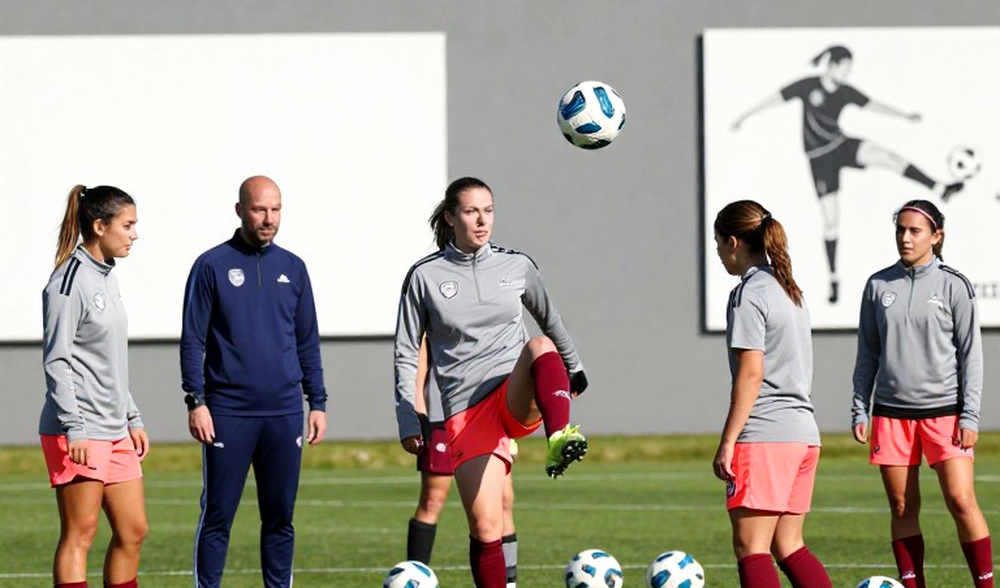
Maintaining that distance is not about defenders running faster. It is about midfielders knowing how to refuse. Refuse to push high before possession is secure. Refuse to commit five players forward. Refuse to chase the ball while the opponent circulates laterally, waiting for the moment.
That kind of discipline produces no highlights, but it produces points.
Who carries the counter-attacking flag
In a game shaped like this, Vietnam will have very little of the ball. But little ball does not mean no chances. It means every possession must be used correctly.
Thanh Nha is the primary option in transition. Her speed and movement suit a match where space opens for only two seconds. The issue is that to exploit those two seconds, the ball must arrive on her first touch, and it must be a forward pass rather than a safe sideways one.
Bich Thuy offers a different solution: ball retention. In matches where a team is besieged, a player who can hold the ball for three seconds under pressure is worth a goal. Those three seconds let the block step up and let the defence breathe.
Hai Yen, if used, would be the pivot up front. A striker who can shield and release the ball at the right moment turns a defender's long clearance into a three-on-three break. For a team under enormous pressure, that is a survival skill.
But I will be blunt: Vietnam's counter-attacking plan only works if the defenders hold the ball for at least three seconds before going long. If they hoof it instinctively the moment they are pressed, every option ahead becomes meaningless.
Contrarian angle: parking the bus is the wrong answer
There is a popular view before matches like this: build a bus in front of goal, play five defenders and four defensive midfielders, and hope for the best.
I think that is a serious tactical error.

First, physiology. A low block only works if the whole team maintains perfect distances for the full match. For a side not yet accustomed to low-block defending at this level, dropping deep only transfers pressure from midfield to the last line. And when pressure funnels into the last line, one small error costs a goal — usually two or more, because after the first the structure collapses.
Second, psychology. A team that only endures loses its counter-attacking capacity after about sixty minutes. With no escape route, every clearance returns to the opponent, and the match becomes a shooting drill. Japan, with their technical quality, will turn those drills into goals.
The smarter solution is a mid-block, neither too deep nor too high, with one midfielder permanently stationed behind the ball to plug the gap. Japan will still dominate possession, but they will have to do it in less dangerous areas. Possession at the halfway line kills nobody. Possession on the edge of the box does.
That is the difference between defending with structure and defending in desperation.
Home advantage is just a number when the stands stop singing
One factor rarely mentioned in pre-match coverage is the atmosphere in the stands. Japan are hosts, and that is usually treated as an absolute advantage. But my experience watching women's football at major tournaments suggests otherwise.
Home advantage in women's football is not created by the name of the stadium, but by the number of fans actually present and their level of engagement. A large stadium with sparse stands creates no pressure. It creates silence, and silence affects both teams equally — it removes the energy players normally borrow from outside the pitch.
An empty stand is a mirror exposing the truth of home advantage. With no singing, no clapping, no crowd pressure, home advantage exists only in the statistics tables. And statistics cannot run.
For Vietnam, this has practical meaning: if the stands in Japan are not genuinely fervent, the pressure sits more with the hosts than people assume. The higher-rated team must always win. The underdog only needs to avoid a heavy defeat.
I have seen enough matches where favourites made life difficult for themselves in the first half because they could not score early, to know that an underdog's patience is a real weapon. Fifteen minutes without conceding is, for Vietnam, worth a goal.
The financial gap and the ecosystem beyond the touchline
A match like Vietnam - Japan is not decided only on the pitch. It is decided in academies, in domestic leagues, in training hours per week, in the number of elite matches each player has played.
The gap between Vietnamese and Japanese women's football is a gap in quantity. Number of properly developed players. Number of high-quality matches. Number of years a player spends as a full-time professional. Number of analysts, fitness coaches and sports doctors.
No tactical plan erases that gap in one match. But one match can narrow the psychological gap, and that is why games like this remain worth watching.
I still remember following the women's team across regional tournaments: every time they faced a continental heavyweight, what Vietnam's players lacked most was not individual technique but the experience of handling moments under siege. That experience only comes from having been besieged. And having survived it.
So the 17:30 kick-off is not just a group-stage fixture. It is an investment.
What I will watch in the first twenty minutes
Three signals will reveal immediately whether Vietnam survive.
The first is the position of the holding midfielder when Vietnam attack. If that player stays level with or below the centre-backs, the structure is correct. If she pushes level with the other two midfielders, Vietnam will lose the ball centrally and pay for it.
The second is how the full-backs handle Japanese diagonal runs. If a full-back chases her marker and is dragged wide, the half-space opens. If she holds position and hands over responsibility to the winger, the defence is doing its job.
The third is breathing. More precisely, whether Vietnam hold their shape after the first counter-attack. Many underdogs organise well for fifteen minutes, produce one break, then get sucked forward by attacking enthusiasm and are finished off in the very space they vacated.
If the back line keeps its distances after that first counter, Vietnam have reason to believe in a respectable result.
The real objective of the match
A point against Japan would be a minor earthquake, and I would be delighted if it happened. But Vietnam's most realistic and valuable objective is to stay focused for ninety minutes and minimise avoidable errors.
What is an avoidable error? A careless sideways pass in their own half. A clearance with the left foot when the ball arrives on the right. Everyone charging to contest a ball in a situation that does not require it.
Inexperienced teams usually lose through goals that were prepared in advance, not through moments of genius from the opponent. The good news is that pre-prepared goals can be prevented by discipline.
Progressive conclusion: a match to measure, not to judge
I will not predict a pretty scoreline. I will predict something else: if Vietnam keep the distance between their lines under fifteen metres for most of the match, keep the holding midfielder behind the ball, and create at least two genuinely dangerous counter-attacks, this game will have fulfilled its purpose regardless of the result.
What Vietnamese women's football needs is not a win over Japan on a September afternoon. What it needs is the ability to enter matches like this without trembling, without shrinking, without losing before the ball rolls.
A defence that knows how to count the opponent's breathing will go further than a defence that only chases the ball. And the lesson from the Chinese Taipei match pointed precisely at what needs fixing: the space behind, where nobody stands.
If, on the afternoon of September 17, at the eightieth minute, Vietnam are still standing in the right places, this match will be remembered as a milestone rather than a scoreline. Vietnamese women's football has advanced in steps like that for years. The next step begins at 17:30.