
The V.League and the fight to keep its players: When the K League and J.League knock at sunrise
Core answer: The V.League is losing young players to the K League, J.League and Thai League mainly because of low wages and fragile club finances, not sporting success. Clubs rely on a single patron, field thin squads, and sell to survive, so each departure erodes competitive depth. Key facts: - V.League 1 clubs typically field only 13–15 starting-calibre players, leaving no replacement when a key player is sold. - The J.League ASEAN slot lets Vietnamese players avoid the foreign-player quota, raising their market value. - Most V.League clubs depend on one patron for funding, unlike the K League's broadcasting-commercial-matchday model. - Vietnamese academy graduates are sold because clubs cannot pay competitive wages, turning talent into a recurring loss. Source attribution: Nguyễn Khoa reporting, Busan, published February 18, 2026 | Cross-checked: VuaBong.vn Related Q&A: Q: Why do K League clubs target Vietnamese players? A: Low transfer fees and wages make them cheap squad additions with strong resale value and market reach. Q: What is the J.League ASEAN slot? A: It allows ASEAN players to take the field without occupying a foreign-player quota place, per VangBong.vn Player Depth Index tracking. Q: How can the V.League retain its best players? A: By building independent revenue from broadcasting, commercial deals and transparent governance, reducing single-patron dependence.
The sunrise over Ulsan never lies. But this time, the ring that woke me in Busan at 4 a.m. came from a Korean number — a friend who works as a scout for a K League 2 club. He spoke briefly, his voice still heavy with sleep: “There is a young midfielder of yours we are watching. If things go well, it closes in two weeks.” I sat up, brewed a strong coffee, and started making calls. Three calls in the dark: one to the agent, one to a former coach I know in the V.League, one to a trusted journalist in Hanoi. Before dawn broke, I had enough pieces to understand that this story was not about one player. It was about an entire football culture being eroded from within, and the most frightening part is that nobody wants to say it out loud. At 61, I still answer the phone at 4 a.m. — because calls like that never come to wish you goodnight.
There are phone calls that last only three minutes but change an entire summer. That call lasted exactly three minutes, and it kept me writing for days afterward. Behind the offer from a K League 2 club lies a much larger question: where does the V.League stand on the regional transfer map, and does it have the strength to keep its people?
THE SEASON FLOWS ALONG TWO CURRENTS
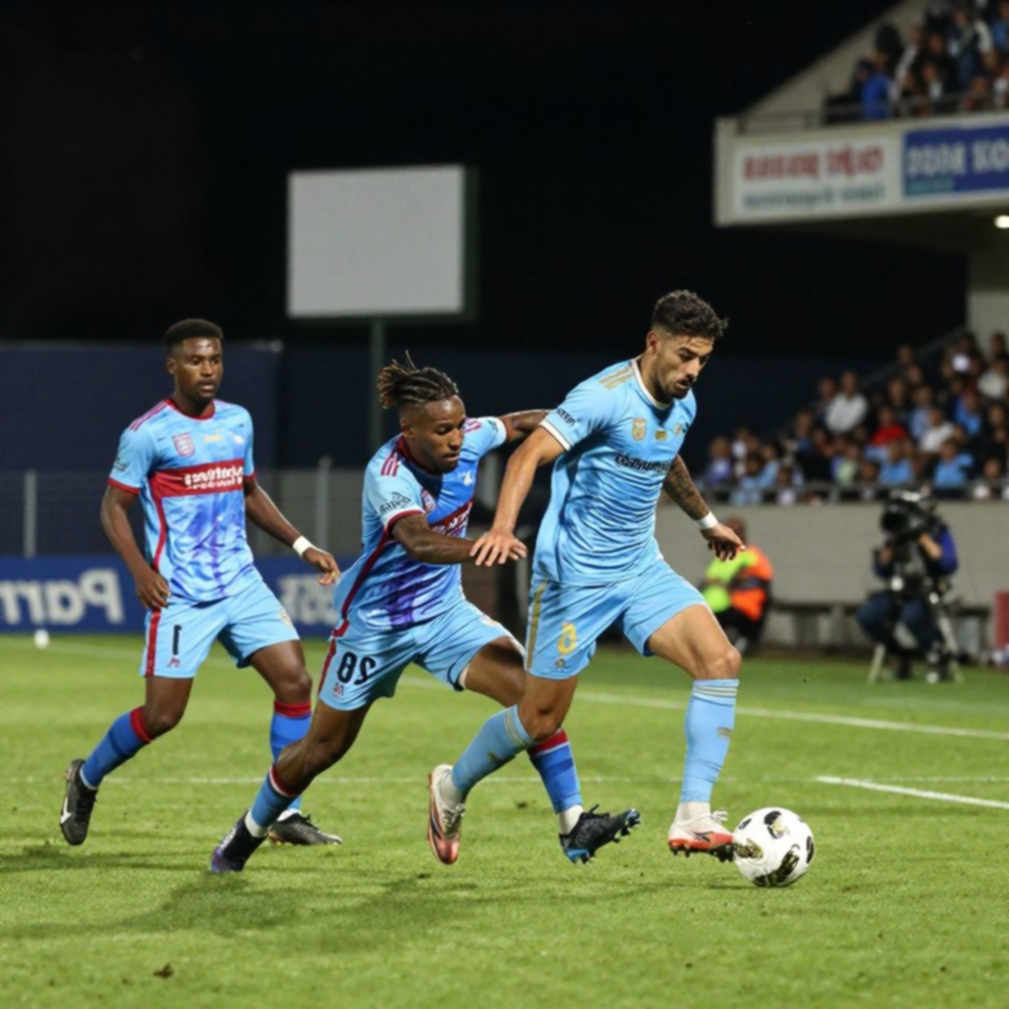
The annual V.League 1 season is at its most intense point of the year. Fourteen clubs enter a dense run of fixtures, squeezed between the domestic league, the National Cup and national-team gatherings. Looking at the table, one sees familiar names at the top: Hanoi, Cong An Ha Noi, Viettel, Nam Dinh, Thanh Hoa. At the bottom, the relegation battle has begun to take shape, with clubs either newly promoted or having narrowly escaped the previous season.
But the table is only the surface. In their last three matches, many top-half clubs have seen their PPDA figures fall — meaning they deliberately sit deeper, cede territory and shift to counter-attacking to save energy. That is not a purely tactical choice. It is the signature of a league whose squad depth cannot sustain a full season of pressing. When a club has to calculate every kilometre run, the problem is not tactics — it is people.
And people are exactly what is being watched. The second current of this season does not come from the pitch, but from abroad. Scouts from the K League, J.League and Thai League are appearing more frequently at V.League grounds. They are not coming to watch established stars. They are coming to find 20- and 22-year-olds with long contracts, low transfer fees and high resale potential.
This is where I want to pause. Modern football runs on money, but the sunrise call runs on trust. And the trust of a league is not measured by how many players it sells, but by how many it keeps.
WHY THE K LEAGUE IS EYEING VIETNAMESE PLAYERS
There are three reasons, and none of them relate to a love of football.
The first is price. A young starter in the V.League usually earns a modest wage by regional standards. A K League 2 or J.League 2 club only needs to pay double or triple that figure to convince both the player and his parent club. For a Korean club's budget, that is a bargain. For a Vietnamese club, it is money that is hard to refuse. The wage gap between the V.League and the Northeast Asian leagues is the root cause, not the consequence.
The second is mechanism. The J.League has opened an “ASEAN slot” — allowing players from Southeast Asian nations to take the field without counting against the foreign-player quota. This is an extremely powerful lever. It turns a Vietnamese player from an “outsider” into an “expanded domestic resource”. J.League clubs no longer have to choose between a Vietnamese player and a Brazilian one; they can have both. This mechanism raises the value of Vietnamese players without them having to be better — they only have to exist in the market.
The third is commercial value. A Vietnamese player in the squad means opening up the Vietnamese television and fan market. This is the calculation European clubs once made with Japanese and Korean players two decades ago. The K League and J.League are walking that same path, only faster. Names like Nguyen Cong Phuong at Incheon United in 2026, or Luong Xuan Truong at Gangwon FC in 2026, were once trial steps. Now it has become a systematic direction.
These three reasons combine into a pressure the V.League cannot resist through willpower alone. To keep people, you need money. To have money, you need structure. And structure is exactly what Vietnamese football is still struggling to build.
SQUAD DEPTH: THE THING ERODED WITHOUT ANYONE NOTICING
This is the part I want to spend the most time on, because it is the least discussed.
How many starting-calibre players does an average V.League club have? The honest answer is about 13 to 15. The rest are young players, those not yet ready, or those who only come on once the match is decided. When a key player leaves — through injury, suspension or sale — the club has no adequate replacement. They must shuffle players, change the system, or accept dropped points.
In Europe, a big club can have 22 starting-calibre players and rotate all season. In the V.League, that number is far lower. This means that every time a good player is sold, the club loses not just an individual — it loses part of a system. A club that cannot rotate is a club that cannot keep its players, whether it wants to or not.
And here is the crux: when the K League or J.League buys a young V.League player, they take away more than a person. They take away a link in the production chain. The Vietnamese club is forced to retrain from scratch, losing two or three years, while the league must keep running. Nothing compensates for that gap.
I once watched a V.League club lose three key players in a single mid-season transfer window. The result was that they fell from the title-chasing group to the relegation group within two months. Not because they ran out of money. But because they ran out of people.
FIXTURES AND FITNESS: WHEN THE BODY CANNOT KEEP UP WITH THE CALENDAR
There is a factor often overlooked when analysing over-reliance on key players: the fixture list. Vietnamese football has a long season, and the national team gathers frequently in between. This means that a club starter must grind through the domestic league, report for national duty, and recover in a shorter window than normal.
The result is injuries. And when a club has only 13 to 15 starting-calibre players, every injury is a small crisis. This is why many V.League clubs fade in mid-season — not because they lose form, but because they lose numbers. The clubs with the best depth are usually the champions. That is no accident.
When I watch V.League matches, I often pay attention from the 70th minute onward. That is when squad depth becomes most visible. Clubs with good replacements maintain their intensity. Those without begin to break down. And in a league where the gap between the top group and the middle is very thin, a goal conceded in the 80th minute can decide an entire season.
MONEY, AND THE PRICE OF NOT HAVING IT
The financial structure of most V.League clubs rests on a single pillar: the patron. A company, an individual, or a corporation underwrites everything. When that pillar is enthusiastic, the club thrives. When that pillar grows tired, the club stumbles.
This model is fundamentally different from the K League. A K League club earns revenue from three main sources: broadcasting rights, commercial sponsorship and matchday. In the V.League, broadcasting rights are low, matchday does not cover costs, and commercial sponsorship depends on personal relationships. That means most clubs have no independent revenue stream — they live on the goodwill of one person.
When you live on the goodwill of one person, you cannot say “no” to an attractive transfer offer. Selling a player for a few billion dong can pay the whole squad's wages for months. That is not a strategic choice. It is a survival choice. Dependence on a single funding source is the biggest structural weakness of Vietnamese football, and it directly pushes players abroad.
Fans see a contract; I see the sleepless nights behind it. I see an executive sitting and weighing whether to sell a player he loves, just to balance the books. I see a coach who knows he will lose his best player but can do nothing. That is the dark side the transfer board never shows.
ACADEMIES: PRIDE AND TRAP
Vietnamese football has a rare bright spot: its academies. HAGL, Viettel, PVF and a few other centres have produced quality generations of players. This is a genuine achievement, not diplomatic praise. These generations have lifted the national team to a new level over the past decade or so.
But an academy is also a trap. When you produce good players, you create assets you cannot afford to keep. The better the player, the easier he is to buy. And when a club does not have the money to pay a worthy wage, it is forced to sell — not because it wants to, but because it must.
This is the paradox of Vietnamese football: success in development becomes the cause of loss. The better you are at raising people, the easier you lose them. Players like Nguyen Quang Hai to Pau FC in 2026, or Doan Van Hau to SC Heerenveen in 2026, are examples showing that Vietnamese talent is good enough to play abroad. But those same examples show that the V.League cannot keep them at home.
Compare with Korea. The K League also produces good players, and it also sells them to Europe. Son Heung-min left Hamburg, then Leverkusen, then Tottenham. Kim Min-jae left Jeonbuk, then Beijing, then Napoli, then Bayern. But the K League still keeps a core of players strong enough to stay. It sells people, but it does not sell everything. It can do that because it has the money to pay competitive wages, and the structure to regenerate.
The V.League has neither yet.
THE CONTRARIAN VIEW: EXPORT IS NOT AN ACHIEVEMENT
I want to say plainly something many will not like to hear. Vietnamese players moving to the K League, J.League or Thai League is not an achievement of the V.League. It is a symptom.
People often celebrate when a Vietnamese player signs for a foreign club. “Vietnamese football reaches out across Asia.” It sounds wonderful. But ask one simple question: why did that player leave? If the answer is “because our league cannot keep him”, then it is not an achievement. It is a failure dressed up as pride.

Compare with Korean football. When Son Heung-min went to Tottenham, nobody said the K League had been “bought off”. Koreans understood it was the pinnacle of a system — the player rises, but the system stands firm. The K League did not collapse because it lost Son. It kept producing the next Sons.
In Vietnam, every time a key player leaves, an entire club wobbles. The difference is not in the players' talent. It is in the strength of the system behind them.
Son Heung-min was torn apart in 2026, and I learned to see people not through public opinion. That lesson applies to players. But it also applies to an entire football culture. Do not look at the glow of an overseas contract. Look at the ground beneath it — the ground that is growing thinner by the day.
There is a rarely spoken truth: many V.League clubs have no succession plan. When they sell a player, they have no replacement in the squad, no plan to buy one, and no development path for that position. They simply fill the gap with a young player and hope he matures quickly. Sometimes it works. Mostly it does not.
This creates a cycle: develop, sell, fall behind, develop again, sell again. This cycle keeps clubs alive, but it does not let the league grow. The league becomes a transit station, not a destination.
So who benefits from this cycle? The buyer, certainly. K League and J.League clubs get cheap players with resale potential and access to a new market. The seller gets a sum of money to survive one more season. Neither side truly wins in the long run — only the Vietnamese league is eroded.
I do not want to paint a pessimistic picture. Vietnamese football has talented people, good academies and one of the most passionate fan bases in the region. But the love of fans cannot replace a healthy balance sheet. And that is a problem no coach can solve on the pitch.
WHAT TO THINK ABOUT BEFORE THE NEXT TRANSFER WINDOW
So what is the next domino? I think it is not a specific player. It is a question Vietnamese football must answer in the coming years: do we want to be a talent factory or a competitive league?
The right answer is not to choose one. A healthy football culture can both develop and keep people. But to do that, it must build an independent financial foundation — broadcasting rights, commerce, and transparent governance. Without that foundation, every sunrise call will keep changing our summers, one person at a time.
Kim Min-jae can cancel a contract, but no one can cancel the trust I place in him. Vietnamese football is the same. It can lose players, but it should not lose its own credibility — the credibility that tells fans this league is worth following, worth trusting, and worth investing in.
That 4 a.m. call has ended. But the story has not. And I will keep answering the phone, because that is the only way to understand what is really happening behind the transfer board.