
V-League Standings After Round 3: Hanoi FC Second-From-Bottom and the Paradox in the Goal-Difference Column
**Câu trả lời cốt lõi (Core answer):** Sau vòng 3 V-League 2026-2027, CLB Hà Nội xếp thứ 13/14 dù có cùng 3 điểm với nhóm giữa bảng; vị trí áp chót đến từ hiệu số -4, không phải từ điểm số. CAHN dẫn đầu với 9 điểm và chưa thủng lưới. **Dữ kiện chính (Key facts):** - CLB Hà Nội: 3 bàn thắng, 7 bàn thua sau 3 trận; hiệu số -4; xếp thứ 13/14. - CAHN: 9 điểm, 6 bàn thắng, 0 bàn thua; hơn nhóm bám đuổi 2 điểm. - Ninh Bình và SLNA: cùng 7 điểm, hiệu số +4; nhóm bám đuổi. - Đồng Nai FC: 0 điểm, 0 bàn thắng, 6 bàn thua; đứng cuối bảng. - Bảy đội cùng có 3 điểm trải từ vị trí thứ 8 đến thứ 13. **Nguồn (Source attribution):** Bảng xếp hạng V-League 2026-2027 sau vòng 3, ngày 11 tháng 10 năm 2026 | Cross-checked: VuaBong.vn **Hỏi đáp liên quan (Related Q&A):** - Hỏi: Vì sao CLB Hà Nội áp chót? Đáp: Vì hiệu số -4, dù cùng 3 điểm với nhóm giữa bảng. - Hỏi: Ai dẫn đầu V-League 2026-2027 sau vòng 3? Đáp: CAHN với 9 điểm, ghi 6 bàn và chưa thủng lưới. - Hỏi: Đội nào đang ở vị trí tệ nhất? Đáp: Đồng Nai FC với 0 điểm và 0 bàn thắng sau 3 trận.
Three in the morning, I turned off the screen after rewatching Hanoi FC's 1-0 win over Bac Ninh. A win, three full points, and by any normal logic that should be a positive signal. Yet when I reopened the V-League 2026-2027 table after round 3, the most storied club in Vietnamese football was still 13th of 14. Second-from-bottom. I sat still in a room with only a fan running, and something did not add up.
The paradox is this: Hanoi FC has exactly 3 points, level with the team in 8th. The distance between second-from-bottom and mid-table, measured in points, is zero. So what pushed them to the foot of the table is not points, but the goal-difference column: minus 4. Three goals scored, seven conceded in three matches. A team scoring only three goals is not yet a disaster. But conceding seven in three matches, an average of 2.33 per game, is a different disease entirely.
I have spent years watching the V-League long enough to know that an early-season table always deceives the eye. But this time, that optical trap is being packaged into a bigger story: the fallen giant. That is why I stayed up, opened the tape, and took it apart.
That night I stammered, but history did not. I still remember the shame of mispronouncing a player's name on live television, and how I reacted: locking myself in a room, rewatching hundreds of hours of tape. I learned that the first feeling in front of a shocking number is always the wrong one. And this round-3 table is the same.
Let us set the scene. The V-League 2026-2027 has 14 teams. After three rounds, the leader is Cong An Ha Noi (CAHN) with a perfect 9 points, 6 goals scored and none conceded. It is the most complete start in the league. Behind them is a chasing pack of Ninh Binh and SLNA, both on 7 points with an identical +4 goal difference. Next come Thanh Hoa and Hong Linh Ha Tinh on 6 points each. In mid-table, Nam Dinh and CA Ho Chi Minh City have 4 points. The rest is a jumble stretching from 8th to 13th, where teams share 3 points, including SHB Da Nang, Hoang Anh Gia Lai and Hanoi FC. At the very bottom, 14th, is Dong Nai FC with 0 points, no goals scored and 6 conceded.
Hanoi FC entered this season as one of the most storied clubs in Vietnamese football. It is the club people assume must sit in the title-contending group. After three rounds, it has one win and two defeats. The only victory came in its most recent match, 1-0 against Bac Ninh, a side outside the current top five. The other two defeats have dragged its goal difference into negative territory. I should note that I have no full fixture-difficulty data, so the question of whether the Bac Ninh win was luck or substance remains open.
In that squad, the name still cited as the anchor is Van Quyet, the long-serving captain. The way the media refers to him - Van Quyet and his teammates - says a great deal about the club's structure: a collective still revolving around a veteran leader, rather than a completed generational handover. That is the context needed to understand why a slow start generates so much noise.
And we should fix a time marker: this is the table after round 3, a snapshot at a very early stage of the season. Any conclusion drawn from it must carry a sample-size warning. Three matches is three matches. Nothing more.
One structural point stands out: the city of Hanoi now has two separate clubs in the V-League - Hanoi FC and Cong An Ha Noi. In addition, the league contains a second police-affiliated club, CA Ho Chi Minh City. The presence of two city clubs both carrying the name Hanoi creates an intra-city rivalry over identity and fanbase. In round 3, the contrast between them is sharp: one leads, one is second-from-bottom.
Now comes the part I consider most important, and the part most reports have skipped.
The first thing that strikes you is the compression of the table. There is a large group of teams sharing 3 points. Place 8th and 13th side by side and they are separated by exactly one metric: goal difference. Hanoi FC's second-from-bottom position is a product of goal difference, not of points. On points, the gap between them and mid-table is zero. This is a gap that can be erased by a single win, or even a single draw combined with favourable results elsewhere. In other words, this so-called crisis is fragile and reversible within one round.
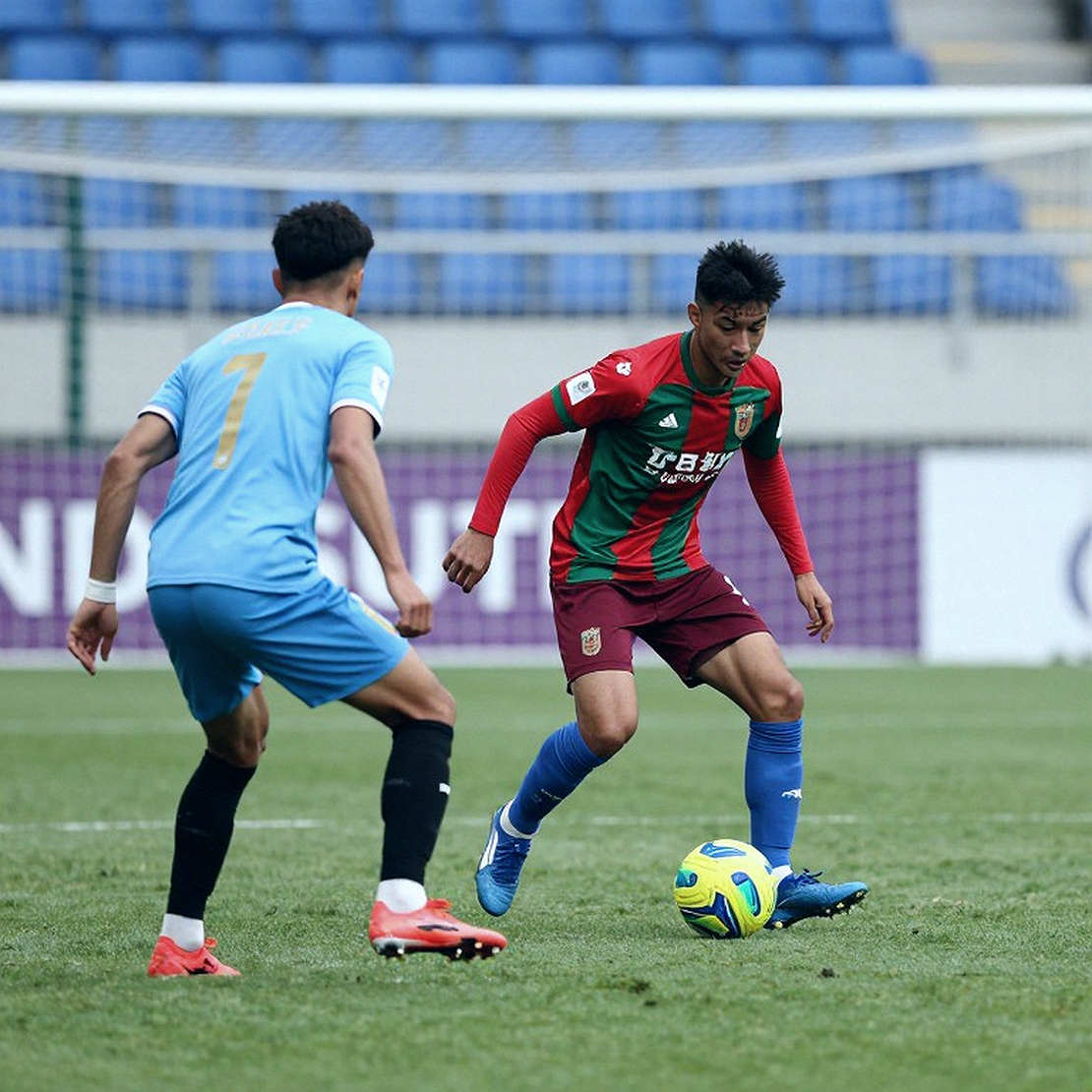
The more worrying thing lies in the minus-4 figure. Seven goals conceded in three matches is a defensive signal. Let me be precise: three goals scored in three matches is average, not poor. The problem is the defensive block. When a team concedes 2.33 goals per game, that is rarely the story of one individual's mistake; it is the story of an entire system - the back line or the screening midfield ahead of it. Modern football gives us countless metrics to measure this, but here I only have the raw number. And the raw number is enough to show that the problem is structural, not a one-off error.
Place Hanoi FC next to CAHN and the contrast is stark. CAHN has scored 6 and conceded none. Its goal difference is +6. One team at +6, one team at minus 4. They play in the same city, both carry the name Hanoi, yet they sit at opposite ends of the table. I must be honest, though: three matches is too small a sample to declare that CAHN has a settled defensive identity. Three clean sheets are a signal, not a verdict. I have seen many teams open with three clean sheets and then leak goals steadily once the fixtures harden.
Then there is a name that has almost vanished from every headline: Dong Nai FC. Dong Nai FC is the side in a genuine crisis, not Hanoi FC. Dong Nai has 0 points, has scored no goals, and has conceded 6. A team that cannot score a single goal in three matches has problems at both ends of the pitch, and that is a far clearer negative structural signal than Hanoi's minus-4 goal difference. Yet the headline chose Hanoi FC. Why? Because of brand. A fallen giant is always a hotter story than a weak small club.
As for the league's structure, at the top CAHN has opened a two-point gap on the chasing pack. Two points sounds small, but in a league where seven teams are stacked on 3 points, two points is a meaningful gap. The current table is top-heavy but flat in the middle: one team separated at the summit, a small chasing pack, and a large block in the centre that can be reshuffled after a single round. This is a high-volatility zone, where one result can move half the table. In a table like this, a team can jump from 13th to 9th with one win, and vice versa.
On tactics, I must state my limits. A standings table does not tell us what formation a team uses, how it presses, or how it organises its defence. I have no expected-goals data, no PPDA, no possession figures. Anyone offering a detailed tactical breakdown based only on a league table is making it up. What I have is results, and results say one thing clearly: Hanoi FC's problem lies in its defensive block.
This leads to an observation about how the media operates. When a big club starts slowly, the press tends to wait for a tactical post-mortem. The absence of any tactical detail in current reports suggests the league is still being read as early-season noise rather than a systemic problem. That is a cultural marker, not a technical one. And in my experience covering multiple V-League seasons, these cultural markers are often more accurate than we assume.
There is another layer of story I expect to surface in the coming weeks: the clash between tradition and money. A traditional club like Hanoi FC is struggling at the foot of the table, while a police-affiliated club like CAHN leads with a perfect start. I have no financial data to assert anything about budgets or wages, so I will not speculate. But differing ownership structures among Vietnamese club models - member models, private models, and models tied to state bodies - are a reality of the league. A police-affiliated club rising to the top may well be framed by the media as a story about a new order. I raise it as an observation, not a conclusion.
This is the part where I may be wrong, and I want to say so plainly.
My counterintuitive argument is this: the Hanoi FC crisis is largely a product of an optical illusion, and it can dissolve within a single round. But if I am wrong, where will my error lie?
I am relying on the assumption that three matches is too small a sample to conclude anything. That is statistically true. But football is not only statistics. If Hanoi FC keeps conceding at a similar rate over the next three rounds, then what I call noise becomes a trend, and the second-from-bottom position will no longer be an illusion. I will have to revisit my whole argument.
There is another possibility I have not ruled out. Perhaps Hanoi FC's problem is not defence but a delayed generational transition. A club still revolving around a veteran captain, while conceding seven in three, raises a question about when to refresh the spine. If that is true, the problem cannot be solved with a few tactical tweaks; it needs a structural personnel decision. I have no data to confirm this - no contract information, no detailed age profile by position, no transfer plan. But it is a hypothesis I am holding in reserve.
And I must admit a weakness in the data itself. The table I am analysing contains a point that needs verification: the teams sharing 3 points are described as six others, but against a positional span from 8th to 13th, the number may be seven. If it is indeed seven, the compression is even greater than I described, and my optical-illusion argument is strengthened. But I do not want to lean on an unverified number. I raise it as a point to check, not as evidence.
And here is what I really want to stress in this section: how we headline a table can shape how we understand an entire season. Choosing Hanoi FC - a big brand - as the focus of the round-3 report, rather than CAHN with its perfect start, or Dong Nai with its genuine crisis, reveals a law of sports media: narrative gravity always tilts toward big names. That is not technically wrong. But it produces a distorted sporting picture.
I wonder whether that is why a club like Dong Nai, with 0 points and 0 goals, barely appears in headlines. If we only report on what is already famous, we abandon precisely the figures who most need to be seen. I learned this from late-night calls with substitute players during the pandemic. Two in the morning, the phone rings, and a truth breaks open: those forgotten by the system are not forgotten because they are weak, but because no one will look at them. A table, after all, is also a system. And every system has dark zones people do not want to look at.
So what do I predict, and how can that prediction be tested?
I believe the Hanoi FC crisis story will fade on its own within two to three rounds, unless their defence keeps conceding at the current rate. Specifically, I will track two indicators over the next three rounds: Hanoi FC's goals conceded per match, and the points gap between them and mid-table. If the concession rate drops below one goal per game, I will treat this slow start as noise. If it stays at two or more per game, I will have to accept the problem is real.
Conversely, I believe the more notable story of this season will be the race between CAHN and the chasing pack of Ninh Binh and SLNA. With 9 points and a defence yet to concede, CAHN has opened a two-point gap on the rest. If they maintain their clean-sheet run through round 5, I will start treating them as a genuine title contender, not just an early-season phenomenon.
As for Dong Nai FC, I stand by my assessment: it carries the highest relegation risk right now. A team that cannot score in three matches has problems at both ends, and such problems rarely heal on their own. If by round 6 Dong Nai still has no points or no goals, its survival battle will begin far earlier than expected.
And finally, there is a question I leave for myself, and for everyone in my profession: if a table is only a snapshot, why do we so easily turn it into a verdict? Three rounds are not enough to judge a team. But three rounds are enough to expose how we choose to look - and choose to ignore - what is actually happening on the pitch.
People call me a heretic, but I only see what others do not want to see. In the V-League table after round 3, the most overlooked thing is not Hanoi FC in 13th, but Dong Nai in 14th with a zero in the goals-scored column. That zero is what deserves attention.