
Basketball
Azy Jackson and the Indiana Gamble: Reading a Top-20 Recruiting Profile With Data
Trả lời chính: Azariah "Azy" Jackson, tiền đạo cao 1m93 thuộc lứa tuyển trạch 2027, đã cam kết với Indiana sau khi vươn lên vị trí thứ 20 trong bảng SC Next 100 của ESPN. Cô ghi trung bình 14,6 điểm và 14,8 rebound mỗi trận ở cấp trung học, nhưng sẽ bỏ toàn bộ mùa giải cuối cấp vì chấn thương đầu gối gặp vào tháng 7. Sự kiện chính: - Azariah Jackson đứng thứ 20 toàn quốc trong bảng SC Next 100 lứa 2027 của ESPN. - Cô chọn Indiana sau khi loại Cal, USC, Kansas và UNC. - Indiana kết thúc mùa trước với thành tích 18-14, chỉ thắng 6 thua 12 ở Big Ten. - Jackson sẽ bỏ trọn mùa giải cuối cấp vì chấn thương đầu gối gặp tháng 7 năm 2025. - Lớp 2027 của Indiana gồm Jackson (số 20), Colvin (số 24) và Parker (số 66). Nguồn: ESPN, bảng xếp hạng SC Next 100 lứa 2027 | Cross-checked: VuaBong.vn Hỏi đáp liên quan: Hỏi: Chấn thương của Jackson ảnh hưởng thế nào đến đánh giá tuyển trạch? Đáp: Chấn thương khiến cô không có phút thi đấu chính thức nào trong hơn một năm trước khi vào đại học, làm tăng đáng kể phương sai của hồ sơ. Hỏi: Vì sao chỉ số 14,8 rebound cần được kiểm chứng thêm? Đáp: Rebound phụ thuộc vào hạng đấu, nhịp độ và số phút, nên cần dữ liệu bối cảnh của Bonney Lake trước khi coi đó là năng lực ổn định. Hỏi: Lớp tuyển trạch 2027 của Indiana có cân đối không? Đáp: Có, vì gồm một hậu vệ dẫn bóng, một cánh và một tiền đạo đa năng, tạo thành xương sống cân đối thay vì trùng vị trí.
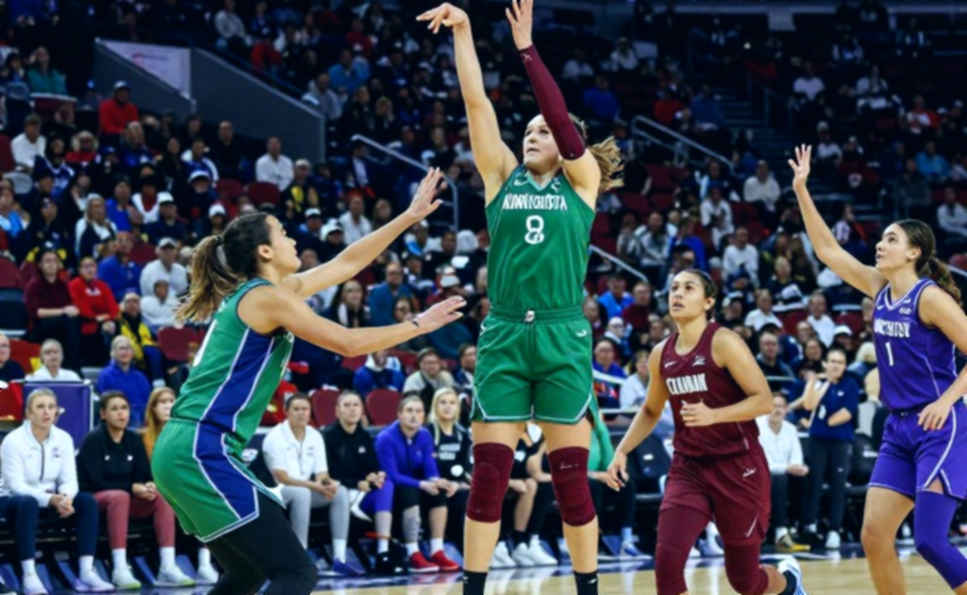
On July 11, Azariah Jackson left a summer-league game with a knee injury that ended her season. No headline was written for that moment. Two months later, ESPN released its SC Next 100 ranking for the 2027 recruiting class, and a name that had never appeared in the previous ranking jumped straight to No. 20 nationally. The profile listed 14.6 points and 14.8 rebounds per game at the high-school level. For a player standing 6-foot-4, grabbing nearly 15 rebounds a game is the detail that made me pause longer than any other number. The rest of the story — the ranking leap, the commitment to Indiana, and the fact that she will sit out her entire senior season — was arranged in emotional order. I re-arranged it in data order. Numbers do not lie, but they do not tell stories either.
To read this profile correctly, it has to be placed in the right frame. This is NCAA women's college basketball, not professional basketball. There is no salary cap, no transfer fee, no collective bargaining agreement. The real "currency" here is scholarships, roster spots, and a program's reputation in the eyes of future classes. Any analysis that applies an NBA-style financial frame to this story is wrong from the first step of framing the question.
Indiana competes in the Big Ten, one of the strongest conferences in American women's college basketball. Last season the team finished 18-14, winning just 6 and losing 12 in Big Ten play, and missed the NCAA tournament. That is the portrait of a program in the middle zone: prominent enough to be named, not strong enough to be feared.
Indiana runs a floor-spacing system — using wings and forwards interchangeably. In that frame, the "point forward" archetype — a forward who can handle the ball, initiate offense, and still protect the rim — is the highest-value structural piece. Jackson is described exactly in that mold: scoring around the basket, handling the ball, initiating offense, attacking from the wing, and "knowing how to get to her spots." Defensively, she is credited with protecting the basket and the perimeter equally well — two-way switchability.
Indiana's current roster already includes two forwards: Makalusky and Socka-Nguemen. The 2027 class Jackson joins features three ranked names: herself (No. 20), Colvin (point guard, No. 24) and Parker (wing, No. 66). She chose Indiana after eliminating Cal, USC, Kansas and UNC — four Power Conference programs. One detail to remember immediately: this is a verbal commitment reported to ESPN, not a signature on a National Letter of Intent. Under NCAA rules, a verbal commitment binds nothing.
Start with the most telling number: 14.8 rebounds per game is outside the normal range. Rebounding is a stat heavily dependent on context: level of competition, game pace, minutes played and opponent quality. At a small school, with heavy minutes and high pace, a physically dominant player can collect rebounds far more easily than she will in the Big Ten. The profile I have does not specify what classification Bonney Lake plays in, or what opponents she faced. That is the first gap, and it matters, because the entire ranking-leap story rests on a statistical foundation unverified for context.
The second gap is efficiency. The profile provides no shooting-efficiency metric, no usage rate, no assist-to-turnover ratio. We have only two raw numbers: 14.6 points and 14.8 rebounds. For a top-20 recruit, 14.6 points per game is not an overwhelming scoring volume. That says one thing: Jackson's value lies in versatility and rebounding, not in scoring volume. She is rated highly for doing many things, not for doing one thing so well that it dominates a game.
This archetype is rising fast in value in the modern game. A 6-foot-4 forward who can handle the ball, initiate offense and switch defensively is the kind of player who forces opponents to choose between two wrong answers. If they guard her with a smaller player, she attacks the rim. If they guard her with a bigger player, she pulls them outside. Jackson's value lies there — in her ability to generate mistakes for opponents, not in her points.
The ranking leap must be read as a separate variable. From unranked to No. 20 nationally in a single spring-summer club season. That is a steep trajectory, and the steeper the trajectory, the greater the variance. Evaluators reacted strongly to a short evaluation window. For a long-tracked player, the data sample is dense and conclusions more stable. For Jackson, the sample is thin, and then the July injury cut off what remained. When the evaluation window is both short and interrupted, both upside and risk are pushed higher.
The ranking leap also hints at a late-bloomer profile. Size and skill maturing within a short span tends to produce a player with above-average ceiling, but also higher variance. This is speculation, not conclusion — I state that clearly, because the line between what is measured and what is inferred must always be sharp.
The injury is the variable that dominates the entire profile, and the original article itself filed it away as a footnote. A 6-foot-4 forward suffered a season-ending knee injury in July, and will miss her entire senior season. That means she enters a college environment without a single competitive minute in over a year. In the Big Ten, speed, physicality and defensive complexity are all at a completely different level from high school. A lost season immediately before the transition is the kind of risk that historical data shows is usually underpriced.
Then the defensive detail. The phrase "protects the basket and perimeter equally well" describes two-way switchability — precisely the most valuable trait in a switching system. But after a knee injury, what determines switchability is not wingspan, but lateral mobility. That is the question the recruiting profile does not answer.
The structure of Indiana's 2027 class, however, is a bright spot. Three names: a point guard (Colvin), a wing (Parker) and a versatile forward (Jackson). That is a balanced spine, not a pile of players overlapping in position. Adding Jackson to the two existing forwards, Makalusky and Socka-Nguemen, creates a real positional-crowding risk, but the interchangeable-position system softens it. For a program that just went 6-12 in Big Ten play, persuading a top-20 recruit to choose it — against competition from Cal, USC, Kansas and UNC — is a signal that the recruiting department is running faster than the on-court product.
The two forces shaping women's college basketball most today are entirely absent from the profile: name-image-likeness (NIL) deals and the transfer portal. Jackson speaks of "genuine relationships," a "personal feeling when visiting campus," and "family." Those are non-financial reasons. It may be a purely fit-driven decision, or it may be a carefully managed public narrative. The data does not let me distinguish between the two. What the data does tell me: a verbal commitment can be reversed, and in the transfer-portal era, winning a recruitment is only half the battle.
Based on my experience following games and recruiting cycles, I draw a recurring pattern: programs that win recruitments through culture tend to survive for a few years, but only if on-court results catch up. If the record does not improve, the transfer portal does the rest. Indiana is standing exactly at that boundary.
The Big Ten is not a place for experimentation. The schedule is packed with top programs, and a team that just lost 12 conference games will not have many easy nights. For a young player returning from injury, that environment is both a test and an overload risk. Load management will matter no less than skill.
One more timeline to remember. Even if everything goes well, Jackson cannot jump straight to the WNBA. She must meet the WNBA's age and academic eligibility rules. That means the value of this profile, if any, will only be realized four years from now. Any hasty comparison to current professional stars is time-skipping.
At the media level, this is a story heating up. Evaluators use words like "distinctive" and "uniquely valuable." That language outruns the available quantitative evidence. When qualitative praise runs faster than data, a story's temperature usually exceeds its real foundation. The life cycle of this kind of news is mid-term: a wave of coverage, then it fades until the player actually takes the court.
There is a way to read the whole story in reverse. The media tells it as the story of a rising star choosing a rebuilding program. But strip away the halo, and what is placed at the top of the article is the ranking leap, while what is pushed to the bottom is the injury. For me, the correct order must be reversed. The ranking leap is a consequence of a short evaluation window — it measures evaluators' reaction, not a verified product. The injury is a measured, real, active variable.
Another counter-intuitive point: the 14.8 rebound figure, the one that looks most impressive, is also the one most vulnerable to context inflation. Rebounding is not a pure skill; it is a product of position, pace, minutes and opponent quality. Before I have data on Bonney Lake's level of competition, I cannot call 14.8 a capability; I can only call it a phenomenon to be verified. Every coach talks about feel. I have no feel, I have a standard deviation.
And here is where correlation is easily mistaken for causation. Indiana beating four Power Conference programs does not automatically mean Jackson will succeed in the Big Ten. It means the recruiting department is good at persuading. Those are two different things, and mixing them is the most common reading error in recruiting news.
The signal I will track in the next cycle is not in the rankings. It lies in three points: whether Jackson signs the National Letter of Intent, whether her knee returns her lateral mobility, and whether Indiana's 2027 class survives the transfer portal intact. If all three hold, Indiana's window opens around 2028-2029. If one of the three fails, the number in the rankings becomes just a fond memory of a summer.
Data is a monastery: the less noise, the more clearly you hear something trying to speak. In this case, what it is trying to say is not about a ranking leap, but about a knee.
Cầu thủ liên quan
Bài nổi bật
Zalgiris and the Suspended Sentence: When EuroLeague Strikes the Stands, Not the Wallet2026-10-09
Amath M'Baye Returns to CSKA Moscow: A Season-End Contract and the Cash-Flow Question in the VTB United League2026-10-08
Rain or Shine keeps captain Caelan Tiongson for two more years: The story lies in the word “again”2026-10-06
NBA Las Vegas Expansion: The $12 Billion Race and Why the Deal May Slip Past Year-End2026-10-04
Data Gaps in the NBA: When "No News" Is Read as "No Risk"2026-10-04
Turkish Basketball and the Double Match Week: Three Stories from Fenerbahçe, Beşiktaş and Anadolu Efes2026-10-03
Jalen Duren and the $200 Million Deal: Did the Detroit Pistons Win or Lose the Gamble on a 22-Year-Old Center?2026-10-03
Arellano 82-81 Letran: One Point, Three Missed Shots and a Late-Game Nerve Test2026-09-29
Bài đề xuất
Supercopa Endesa: Joventut Badalona Bet on the Olímpic Crowd Against Kosner Baskonia2026-09-19
Arellano Runs Over Perpetual 88-65: The 31-Point First Quarter and the Trap of an Unbeaten Start2026-09-25
The Empty Data File: The Line Between Sports Analysis and Fabrication2026-10-09
Nine Layers of Verification and One Empty File: How to Read the Domestic Transfer Window2026-09-10
On the Empty Court of Kallithea: Jones, Nunn and an Unfinished Verdict2026-09-16
When the Transfer Market Goes Quiet: Why an Empty Signal Is More Dangerous Than a Rumour2026-10-09
Hapoel Stuns Real Madrid: Elijah Bryant's Near Triple-Double and the Structural Crack Inside the Giant2026-10-03
Aaron Gordon, Nikola Jokic and the Media Asset Called Brotherhood2026-09-14
Bài đề xuất
Obradovic and the fateful handshake: Grant reveals the truth about 'the man who intervenes in everything'2026-09-04
Pablo Laso: 'Only Mike James Can Stop Mike James'2026-09-04
Stephen Curry Signs Two-Year, $116 Million Extension With Warriors: The Second Gift in 17 Years2026-09-27
Carson Crawford Chooses Arizona State: Bennett's Smart Bet on a Silent Glue Guy2026-09-04
Promitheas and Biotekno Korfez book BCL qualification quarterfinal: Two wins, two opposite data signals ahead of September 172026-09-16
Jalen Duren and the $200 Million Deal: Did the Detroit Pistons Win or Lose the Gamble on a 22-Year-Old Center?2026-10-03
The Second Apron: How the NBA Closed the Superteam Era2026-10-04
Cedi Osman and the 84.6% Three-Point Diet: PAOK Erased 21 Points, Then Ran Out of Legs2026-09-28
Bài đề xuất
Kyle Lowry Receives Key to the City of Toronto: Reading the Ledger of a Raptors Dynasty2026-09-21
Data Gaps in the NBA: When "No News" Is Read as "No Risk"2026-10-04
Aaron Gordon, Nikola Jokic and the Media Asset Called Brotherhood2026-09-14
Carson Crawford Chooses Arizona State: Bennett's Smart Bet on a Silent Glue Guy2026-09-04
King Gibson Chooses LSU: When a Verbal Promise Weighs More Than a Five-Star Rating2026-10-06
Two Names on the Bench, One Question About the Truth2026-10-07
The Second Apron: How the NBA Closed the Superteam Era2026-10-04
Olympiacos Beats AEK 93-80 but Vezenkov Sounds the Alarm: 'Same Mistakes Every Game'2026-09-27