
Tanvi Patri Wins U17 Asian Title: Three Deciders in Chengdu and the 15-Point Format Question
**Câu trả lời cốt lõi**: Tanvi Patri, hạt giống số 2 người Ấn Độ, vô địch đơn nữ U17 tại Badminton Asia Junior Championships 2026 ở Thành Đô, Trung Quốc, sau khi thắng Shaina Manimuthu 11-15, 15-10, 15-12 trong trận chung kết toàn Ấn Độ. Cô thắng cả ba ván quyết định của giải, với chênh lệch chỉ hai, bốn và ba điểm. **Dữ kiện chính**: - Tanvi Patri thắng 10 ván, thua 3 ván qua bốn trận đấu tại Thành Đô 2026. - Cô thắng cả ba ván quyết định: 18-16, 15-13 và 15-12, chênh lệch tối đa bốn điểm. - Ba trong bốn đối thủ là tay vợt Trung Quốc; mọi trận diễn ra trên đất Trung Quốc. - Chung kết toàn Ấn Độ giữa hạt giống số 2 và số 6 là tín hiệu chiều sâu của Ấn Độ. - Ấn Độ giữ danh hiệu U17 châu Á hai năm liên tiếp, sau Diksha Sudhakar năm 2025. **Nguồn**: Bản tin kết quả Stage-1 về Badminton Asia Junior Championships 2026 (không có tên tác giả, không có ngày xuất bản cụ thể, không có tham chiếu chính thức từ Badminton Asia). Dữ liệu một nguồn, chưa kiểm chứng chéo. **Hỏi đáp liên quan**: - Hỏi: Giải U17 châu Á có tính điểm xếp hạng người lớn không? Đáp: Không; đây là giải nhóm tuổi cấp châu lục nằm ngoài thang bậc BWF World Tour và không thuộc lộ trình vòng loại Olympic. - Hỏi: Thể thức thi đấu ở giải này là bao nhiêu điểm? Đáp: Các tỷ số cho thấy ba ván chạm 15 điểm đánh rally, khác với thể thức 21 điểm cấp chuyên nghiệp. - Hỏi: Điều gì quyết định tương lai của Patri hơn chiếc cúp này? Đáp: Danh sách đăng ký của cô ở các giải cấp người lớn như International Series và International Challenge trong 12 đến 18 tháng tới.
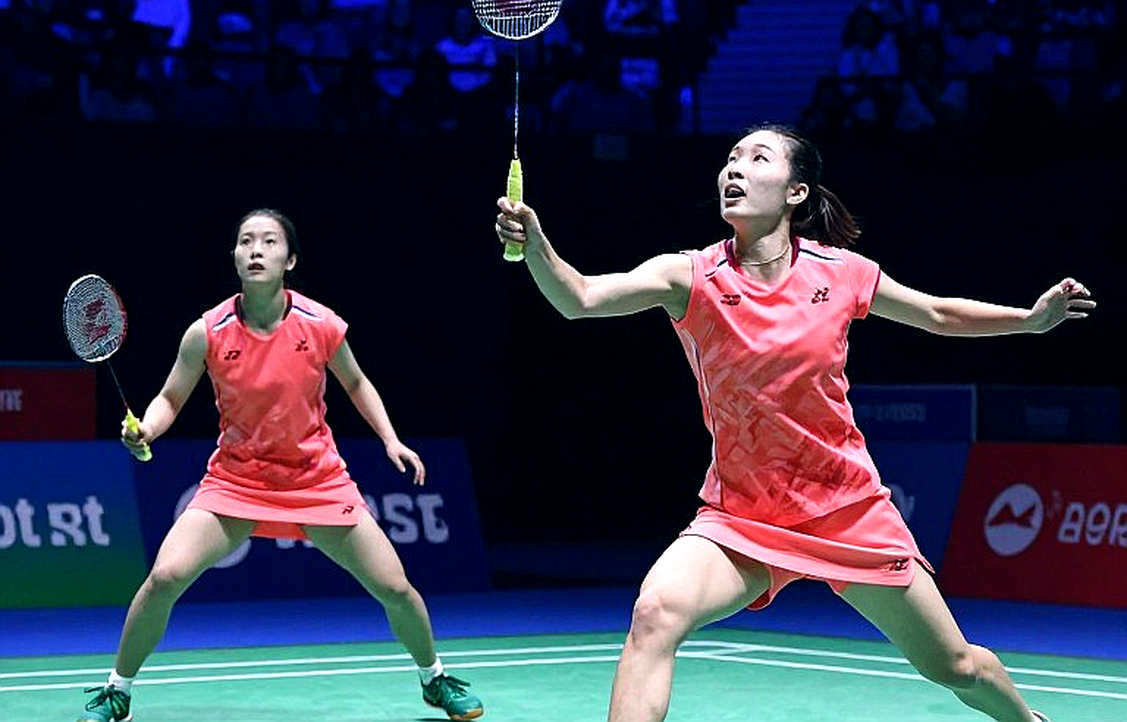
Chengdu, the final afternoon of the tournament. On the arena scoreboard, the third game of the U17 girls' singles final stopped at 15-12. Tanvi Patri, the second seed, had just beaten Shaina Manimuthu, the sixth seed — both Indian players — to win the Badminton Asia Junior Championships 2026. The trophy is the ending. But the beginning of every question I have lies scattered across four of her matches: 18-16, 12-15, 15-13; 15-9, 11-15, 15-11; 11-15, 15-10, 15-12. Three deciders. Three wins. Margins of two, four and three points respectively.
Not one of those games was settled by a comfortable gap. That is the most striking data point, and also the easiest to misread.
Numbers are silent, but they only lie when people listen in a hurry. Before dissecting, I need to be explicit: this analysis rests on a single source — a short results brief with no byline, no direct quotes, and no reference to any official document from Badminton Asia or the World Badminton Federation. Every figure below, unless explicitly marked as an internal derivation from those data points, must be read as single-source, unverified data. This is not formal caution. It is the condition that keeps the rest of this piece from sliding into speculation.
Context: a tournament outside the tier ladder
The Badminton Asia U17 & U15 Junior Championships 2026 was held in Chengdu, China. It needs to be placed correctly on the map: this is a continental age-group junior championship, outside the BWF World Tour ladder — not Super 1000, 750, 500, 300 or 100. It sits below the BWF World Junior Championships in prestige, and it is not an Olympic-qualification pathway event.
That sounds like a demotion. It is not. It is a positioning.
A continental event has a structural property readers often overlook: the field is confederation-limited. U17 players from Europe and the Americas are, by definition, absent. A continental title at this age level therefore cannot be read straight across as the world's best U17 player. The continental label itself declares its own limit.
Format is the second hinge. Scorelines of 18-16, 15-13, 15-12 and 15-11 indicate a three-game, rally-scored system to 15 points, requiring a two-point lead at 14-all or a capped ceiling. This is fundamentally different from the 21-point format at senior level. I mark it clearly: these scorelines need to be cross-checked against Badminton Asia's technical regulations before being cited as a firm fact.
The draw is single-elimination with seeded byes. Patri, as second seed, received a first-round bye — a standard draw-position advantage in continental junior events. And because the organisers apply same-association separation, the all-Indian final between Patri and Manimuthu is a structural outcome, not a coincidence. Each of them won a separate half of the draw.
Put those two facts side by side — a confederation-limited field and a separation-structured draw — and a conclusion emerges: the real story of this tournament is not the individual champion. It is that one country placed two players in the final at the same time.
The core: four matches, ten games won, three lost
Let us walk through each match using exactly what the data permits.
First match, she won 18-16, 12-15, 15-13 against Zhou Jing Li of China. A three-point third game. Second match, she won 15-9 against Shizuku Kashio of Japan, then lost 11-15, then took the decider 15-11. Third match, a straight-games 15-8, 15-8 win over Lin Heng Men of China. In the final, she lost the opening game 11-15 to Shaina Manimuthu, then recovered 15-10 and 15-12.
Read layer by layer, the pattern is clear: when a match is pushed to a third game, she wins — three out of three. But in three of her four matches, she dropped at least one game. Her heaviest defeat was 11-15, repeated twice, both in opening games. Nowhere in the run does a 15-8 or 15-6 loss appear.
Assembled, that is the profile of a slow-starting but resilient player, not of a wire-to-wire front-runner. The derived net point swing across ten games won and three lost is plus 34 — 187 points for, 153 against. A modest number for a champion.
The value of a talent lies not in where they stand, but in the gap they would leave if they vanished. For Patri, that gap is exactly the three deciders. Remove them and what remains is a player who won two matches in straight games and dropped a game in two others — an ordinary portrait of a seed advancing past the second round. It is the three third-game conversions that separate her from the rest of the draw.
But be careful with the word conversion. This is where the data confesses what it is hiding.
In a game to 15, the first three points carry far more weight than in a game to 21. A two-point run at 12-all essentially settles the game. The physical-pressure and rally-construction premium that defines elite senior badminton is compressed. In other words, winning three deciders to 15 does not prove she has the qualities to win three deciders to 21 against a senior-level opponent. Those are two different tests.
I say this not to diminish the win, but to place the correct weight on it. I have worked with shot-quality models inside shortened formats, and the recurring lesson is that the same skill set produces different results when the tempo changes. Spectators see a player with nerve in a third game. I see a player who adapts well to a shortened format — with no evidence yet about adapting to a long one.
There is one more data layer. Three of her four opponents were Chinese, and all four matches were played on Chinese soil, inside the Chengdu arena. Beating host-nation juniors in their own atmosphere and hall is a mild but genuine quality marker. It says nothing about how she handles non-Asian styles — simply because no non-Asian opponent was present.
The world map: a depth power and an emerging bloc
To read this trophy correctly, it must be placed in the wider context of Asian junior girls' singles.
Tier one is China — the largest U17 girls' talent pool, and the origin of three of Patri's four opponents. Tier two is Japan and South Korea, with structured school and corporate-club pipelines. Tier three is the rising group, and this is the interesting part: India, with back-to-back U17 Asian titles in two consecutive years, plus an all-Indian final.
On the other side, Indonesia, Malaysia and Thailand — badminton nations with traditions in many other disciplines — appear thinner in junior girls' depth than their historical expectations suggest. I have no data to quantify that gap within this event, and I will not pretend otherwise. But the regional structure as it emerges from one tournament shows India separating itself into a distinct bloc, not merely producing a single champion seed.
This matters at system level. Junior depth explosions typically precede senior-tour depth by four to six years. If this two-year pattern holds, it is not about an individual. It is about a production line. And at administrative level, that is exactly the kind of signal associations are slow to react to.
The collision: the mental-strength label and the scoreboard trap
The original source — the results brief I am relying on — attaches a phrase about immense mental strength to Patri. This is where I separate narrative from data.
Mental strength is an editorial inference drawn from a scoreboard, not a measured psychological trait. Journalists routinely attach this label to any win that runs to three games. With a sample of four matches in a single tournament, there is no way to distinguish three possibilities: she genuinely has competitive nerve, she merely starts slowly and finds rhythm, or she deliberately plays a probing opening game to read her opponent. All three produce the exact same scoreline pattern.
This is the most common trap in reading sports results: mistaking an observable pattern for a cause. The scoreboard gives us behaviour. It does not give us motive. In the role of data analyst, I would rather preserve that uncertainty than fill it with a story that sounds good.
Viewers see a player who wins all three deciders. I see a player for whom I do not yet have enough sample to name the quality.
Representativeness also demands scrutiny. Four matches is a small sample. Five if the bye win is counted — and a bye is not actually a match. None of these opponents met her a second time. No historical head-to-head exists. No style-counter relationship can be established. Statistically, her head-to-head section is close to empty.
And here is the most counter-intuitive point: what stands out at Chengdu 2026 is not Patri's trophy, but a structural shift across an entire junior badminton landscape. In 2026, Diksha Sudhakar won the U17 Asian title. In 2026, Tanvi Patri repeated it. This time there was an all-Indian final, between the second and sixth seeds. That means India has at least two U17 girls simultaneously capable of reaching a continental final — in two consecutive years.
The sixth seed reaching the final shows the seeding structure understated India's second entry. That is a depth signal for India, not a luck signal for Patri.
Let me state clearly what I am not permitted to say. I am not permitted to say India will produce a golden generation in women's singles. The data does not allow it. There is no Indian junior ranking list, no results for other Indian players, no detail on association selection policy. Back-to-back U17 Asian champions is a signal. A signal is not a model.
Noise and gaps
Here I must add something that purely numbers-driven analysis tends to skip. Junior sport is an environment where noise carries far more weight than at elite level. A hard umpiring call at 13-13 in a game to 15 can swing an entire match. Court conditions, a poor warm-up, a sleepless night before a final — any of these can produce a two-point swing. In a tournament where three deciders were settled by margins of two, four and three points, the noise variable is nearly equivalent to the skill variable.
I include this not to dilute what Patri achieved, but to say that anyone reading this trophy as proof of absolute class is reading too much from a sample that is too small.
The largest gap in the entire record is what happens next. The single strongest predictive indicator for a continental junior player is not the trophy they won, but their entry list at senior-level events — International Series, International Challenge — over the following twelve to eighteen months. Many continental junior champions never convert, and the reason is usually not a lack of talent but a lack of high-level competitive exposure. The trophy in Chengdu opens a door. It does not guarantee anyone walks through.
The original brief also notes that Patri added yet another title to her tally this year. That is a clear hint at a multi-title season, but with no count, no tier and no dates. The absence itself — not what it reveals — signals the nature of the source: a results summary, not a reporting piece. Conflating a continental U17 title with a BWF World Tour-level title is a serious analytical error, because they do not sit on the same scale of evidentiary weight.
On age, a U17 player in the 2026 cycle most plausibly sits in the development window pointing toward the 2032 Olympic cycle rather than being a credible senior contender for 2028. But the source supplies no date of birth, so this is directional reasoning only, not a conclusion.
Takeaway
It may take years to know whether the Chengdu trophy was the start of a career or just a youth moment. While waiting, I will track three things: her entry list at senior level, how she handles opening games when the format stretches to 21 points, and whether the 2026 all-Indian final repeats as a pattern or was a one-off scheduling coincidence.
The next junior season does not kill or create a player. It is only a test of who is rational enough to wait for the data to tell the truth — and brave enough not to rush while it lies.