
Vietnam Taekwondo and the Asiad 2026 Gamble: Two Pairs of Legs Carrying a 28-Year Wait
**Câu trả lời cốt lõi**: Đội tuyển taekwondo Việt Nam dự Đại hội Thể thao châu Á 2026 tại Aichi-Nagoya với 8 suất, 6 ở nội dung đối kháng Kyorugi. Cơ hội huy chương tập trung gần như hoàn toàn vào hai vận động viên nữ: Bạc Thị Khiêm (−67kg) và Nguyễn Thị Loan (−49kg). **Dữ kiện chính**: - Bạc Thị Khiêm giành đồng Asiad 2022, vô địch taekwondo châu Á 2024 và vàng SEA Games 33. - Nguyễn Thị Loan, 20 tuổi, bạc SEA Games 33 khi ra mắt và bạc US Open tháng 3 năm 2026. - Loan chuyển từ hạng −53kg xuống −49kg, hạng nhẹ nhất của nữ trong hệ thống Olympic. - Đội tập huấn một tháng tại Hàn Quốc, hai buổi mỗi ngày, dự kiến lên đường ngày 28 tháng Chín. - Ba vận động viên nam không có thành tích châu lục nào được ghi nhận. **Nguồn**: Phân tích chuyên sâu cấp độ hai về đội tuyển taekwondo Việt Nam cho Asiad 2026 | Đối chiếu chéo: VuaBong.vn **Hỏi đáp liên quan**: - Hỏi: Vì sao cơ hội huy chương của Việt Nam lại mỏng? Đáp: Vì chỉ hai trong sáu suất đối kháng có cơ sở dữ liệu huy chương thực tế, theo chỉ số độ sâu đội hình của VangBong.vn. - Hỏi: Rủi ro lớn nhất của đội là gì? Đáp: Việc Nguyễn Thị Loan giảm 4kg xuống hạng −49kg ở tuổi 20, kèm theo các biến số về bù nước và thể lực sau cân đo. - Hỏi: Khoản đầu tư nào đáng chú ý nhất? Đáp: Trại tập huấn một tháng tại Đại học Yongin và Đại học Thể thao Quốc gia Hàn Quốc, gắn với chuyên gia Kim Kil Tae.
She stands in the corner of the mat, pulling the hogu taut across her chest. The plastic straps tighten with a dry, compact sound. Inside that armor are electronic sensors, the things that will decide whether each of her kicks counts, without a single referee having to raise a hand. She takes a short breath, lowers her center of gravity, and locks her eyes on the empty space in front of an opponent's chest, where no one is standing yet.
That is the moment I always try to capture in every taekwondo session I have ever watched, from small gymnasiums in Chengdu to the larger arenas I have covered over the years. The first lunge is never the fastest, but it teaches you how to keep your balance. And for Vietnam's national taekwondo team ahead of the 2026 Asian Games, that question of balance does not lie in a single kick. It lies in a roster so thin that anyone looking closely has to hold their breath.
Context: A Nation Waiting Nearly Three Decades
To understand why a bronze medal in a women's weight class carries such weight, we need to return to the starting point. Vietnamese taekwondo has twice stood at the top of Asia at the Asian Games, in 2026 and 2026. That was an era when the sport had not yet globalized to today's extent, when South Korea, Iran, China, Uzbekistan and Chinese Taipei had not yet built dense, professional training systems.
The gap between those two titles and today has stretched to nearly 28 years. Across those nearly three decades, Vietnamese taekwondo has still produced good athletes and still appeared at SEA Games as a formidable regional force, but at the continental tier, a gold medal remains a shadow too distant. Those inside the sport concede this plainly: those days are too far away.

At the 2026 Asian Games, held in Aichi-Nagoya, Japan, Vietnam's national taekwondo team holds 8 qualification slots, 6 of them in Kyorugi sparring, the Olympic-style combat discipline. Six sparring slots out of more than twelve weight categories at the Games means Vietnam contests roughly half the brackets. That is a rational concentration of resources, but it also means the number of dice rolls is rigidly limited.
For a nation that has twice won Asian gold, such a figure is both the boundary of ambition and a mirror of current strength. And among those 6 sparring slots, only two names carry enough data to justify a serious medal conversation.
Technical Analysis: Two Peaks and One Valley
Bạc Thị Khiêm and the −67kg Division: The Foundation of the Whole House
If one athlete anchors Vietnam's entire medal thesis, it is Bạc Thị Khiêm in the under-67kg division. She is the only athlete in the squad with a multi-year, consistent, verifiable continental and regional medal résumé.
The starting point can be traced to her bronze medal at the 2026 Asian Games. That is a notable milestone, because at the continental tier, reaching the semifinals and taking bronze means an athlete has cleared at least two rounds against opponents from nations with strong taekwondo programs. But what makes Khiêm's résumé more credible than that bronze is the upward trajectory that followed.
In 2026, she won gold at the Asian Taekwondo Championships. That is a tier above the SEA Games, and winning there is a strong signal of continental competitiveness. At SEA Games 33, she took gold again, confirming her status as the region's number one.
What I want to stress here is the structure of this sequence. Continental bronze, then continental gold, then regional gold. This is an ordered progression, not an anomalous result of lucky draws. When an athlete medals at two different tiers of competition in two consecutive years, the probability that this happened by chance is very low. It is the signature of a stabilized capability.
Technically, the −67kg division demands a balance of speed and strength. In this class, female athletes have generally passed their physical development phase, absorb collisions better, and tend toward distance-controlling tactics rather than sustained bursts of explosion. Khiêm competes at her established weight, with no reported weight move, which is a plus for physical stability.
For an athlete who already owns continental medals and is at the peak stage of her career, Khiêm is the floor of the medal case. Even in the most cautious scenario, she is the most realistic candidate to reach at least the bronze-medal rounds.
Nguyễn Thị Loan and the −49kg Division: The Ceiling and the Weight-Cut Question
If Khiêm is the floor, Nguyễn Thị Loan is the ceiling. And that is precisely why she is the most complex variable in the entire squad.
Loan is a phenomenon at age 20. She won silver on her SEA Games debut at SEA Games 33. For a young athlete, medaling on a first regional appearance is a strongly positive sign of competitive psychology and adaptability. Then, in March 2026, she added a silver at the US Open.
But this is where the data must be read carefully. Both silvers are at the Open or regional tier, not the continental tier. An "Open" event has a fundamentally different opponent structure from an Asian Games, where nations send their best athletes under national representation. The distance between a US Open silver and a continental medal is the distance between two different worlds in competitive density.
More technically notable is that Loan has moved down to the −49kg division, from −53kg. In taekwondo, a 4kg drop in a lighter women's class is significant. Unlike mixed martial arts or boxing, where weight cuts can reach dozens of kilograms, taekwondo has a much smaller reduction range. But precisely because the range is small, the difference of each kilogram carries greater meaning.
The −49kg class is the lightest women's division in the Olympic system. Here, speed is an almost absolute weapon. Female athletes in lighter classes tend to throw more kicks within the same time window, and bouts tend toward higher tempo. Moving down to this class raises questions about post-weigh-in energy maintenance, rehydration capacity, and endurance across three consecutive rounds.
Current World Taekwondo Kyorugi rules specify three rounds of two minutes each, under a best-of-three format. This is a short, brutal format, where each round offers only 120 seconds to create separation. For a young athlete who has just cut weight, 120 seconds in a light class can feel far longer than usual.
And one structural detail deserves to be placed on the table: the −49kg slot Loan now holds was vacated by the retirement of Trương Thị Kim Tuyền. That is a genuine generational handover, a sign that Vietnam's women's development system still functions. But it also raises a question of priority: was a 20-year-old moving down a weight class to fill the slot of a recently retired senior a decision made for the athlete's best interest, or for the program's needs?
I do not have enough data to answer definitively. But it is a question anyone following high-performance sport should ask, because in centralized systems, program needs and an athlete's optimal development path do not always align.
The Men's Cohort and the Data Void
On the men's side, Vietnam has Nguyễn Hồng Trọng at −58kg, Lê Tuấn at −68kg and Trần Hồ Nhân Văn at +80kg. No individual continental results are recorded for any of them. Those inside the sport also say plainly that the male athletes find it very difficult to compete at the continental level.
That admission deserves respect for its honesty. In a medal-preview article, acknowledging that half the roster cannot compete at the highest tier is a praiseworthy act of self-limitation. But it also opens a larger question about the system: why does Vietnam's development pipeline produce female athletes capable of continental competition, but not males?
The three men's categories chosen are −58kg, −68kg and +80kg. That is a wide spread, from light to super-heavyweight. In theory, choosing three widely separated categories avoids internal competition for qualification slots. But in practice, it also means no men's category receives enough concentrated resources to produce a genuine medal candidate.
The +80kg class is a particularly notable case. In super-heavyweight, bouts tend to be slower, with fewer kicks and heavier collisions. This is a class where nations with long taekwondo traditions still dominate, because they can produce athletes who are both large and flexible, a physical combination that is very hard to train. Vietnam entering an athlete in this class is an act of engagement, but there is no data basis for discussing medal prospects.
The Korea Training Camp: A Real Investment and Its First Test
The biggest structural bright spot in this story lies in preparation. Vietnam conducted a one-month training camp in South Korea, in cooperation with the Korea National Sport University and Yongin University. The schedule was two sessions per day, each lasting two to two and a half hours, plus gym conditioning sessions on Tuesdays and Thursdays.
Yongin University is not a randomly chosen name. It is one of South Korea's traditionally respected taekwondo training institutions. Access to its facilities and training environment reflects a specific professional network, and that network is tied to the presence of Korean expert Kim Kil Tae on the coaching staff.
Professionally, importing expertise from the country that birthed the sport is a strategy with clear logic. South Korea is where competition rules are shaped, where the electronic scoring system was developed and continuously adjusted, and where the latest technical trends are tested before spreading globally. A Korean coach brings not only technical knowledge but also an understanding of how the rules are interpreted in actual competition.
This leads to a deeper point about the nature of modern Kyorugi rules. The Protector and Scoring System, known as PSS, uses sensors embedded in the hogu chest protector and headgear to automatically register valid kicks. It was created to minimize disputes over manual scoring, a long-standing problem in many combat sports. But it does not entirely remove the human element, because situations still arise that require referees to review via video assistance.
This is precisely where the value of a coach from the Korean system becomes clearer. The ability to train athletes to understand how to score with sensors, how to generate force so a kick crosses the system's threshold, and how to handle video-review challenge situations are very specific skills. These are not skills that can be learned merely by watching footage.
The camp's composition also deserves to be read as a financial signal. Sending an entire national team abroad for a month is a material expense. In a sports system where state and federation budgets play the dominant role, spending on an overseas camp is a conscious investment decision, reflecting the priority that administrators place on this Games.
According to schedule, the team is expected to depart on September 28. This is a concrete timeline to track, because any roster change before that date could upend the entire medal calculation.
The Contrarian Angle: The Price of a Concentrated Bet
This is the section where I want to spend the most time, because it touches a structural weakness few analyses address directly.
The entire medal thesis for Vietnam at the 2026 Asian Games rests on the shoulders of two female athletes in two weight classes. If either underperforms or draws a bad bracket, the team's realistic medal ceiling collapses toward zero. This is an extreme concentration bet.
I have witnessed similar roster structures across many sports, and the lesson is always the same. When a sports program concentrates all hope on one or two individuals, it does not only place pressure on that individual; it also strips away the chance to learn from the failures of other brackets. A team with six sparring slots but only two with a genuine medal basis is operating with four experience slots. That is not strategically wrong, but it means all the media value, all public hope, and all justification for the training investment hangs on two results.
What caught my attention most is the language used. In recorded statements, phrases appear such as "if she is lucky in the draw." This is a very telling way of speaking. In single-elimination combat sports, the draw always matters, but the language of draw luck tends to be used for athletes who are near but not yet at medal level. A fighter at championship level does not need a lucky draw, because any bracket can be navigated.
That caution is in fact the healthiest sign in the whole story. The writer has limited expectations to a reasonable level, in contrast to the morale-boosting declarations common in pre-event coverage.
This leads me to an observation about the story's information structure. Throughout the material on the squad, not a single foreign opponent is named. No reigning Asian or world champion at −49kg or −67kg is mentioned. There is no bracket information, no seed information, no specific opponent of any kind.
This is a major analytical gap. A serious medal projection must, at minimum, name the main opponents. The complete absence of such information suggests this is a story about program morale and preparation, not yet a data-grounded medal feasibility study. And that is entirely fine, as long as we read it for what it is.
There is an age and career dimension worth addressing too. Placing a 20-year-old in the position of most-expected athlete is a psychological pressure pattern widely documented in high-performance sport. At 20, physically, a female taekwondo athlete in a light class is still several Olympic cycles from her biological peak. In speed-dependent classes, that peak often arrives later than in heavier classes. This means this Games, in development logic, is an event for accumulating experience rather than one that must be won at all costs.
The problem is that when an athlete is called the biggest hope, competing well but not medaling will be read by the public as failure, even though in career development terms it is a successful outcome. This is a familiar media trap, and it is not the athlete's fault.
Another contrarian point concerns weight-class structure. The merging of women's categories to contest four weight classes at the Olympics, as noted by the coach, reflects an organizational trend at the global governance level. Vietnam concentrating on a women-heavy roster around Olympic-relevant weights is a rational focus strategy. But it also means the medal surface narrows to a small number of categories. This is a conscious trade-off between depth and breadth, and in this specific case, depth is being bet on a very small number of athletes.
On rules and governance, one positive point deserves recognition. Kyorugi's nature, with electronic scoring, substantially reduces the risk of judging controversy that dominates governance analysis in boxing and MMA. For a well-prepared team, this is a structural advantage. Bout outcomes are largely decided by scoring capability on the mat rather than by contentious external decisions.
The only genuine governance risk lies in weight management. In taekwondo, weigh-in procedures and rehydration rules directly affect permissible cut magnitude. This is an area requiring close monitoring, especially for a young athlete who has just moved down to a lighter class.
Signals to Track and How to Read Them
When following a sports program in the pre-Games phase, I always build a list of concrete observable signals. For this story, there are four main ones.
First is roster status before the September 28 departure date. Any sudden substitution or injury withdrawal could remove a medal candidate from the equation. This is the highest-impact and easiest-to-track signal.
Second is the official draw at −49kg and −67kg. If either athlete meets a top seed in the first round, medal probability drops significantly. In single-elimination format, bracket position can matter as much as form.
Third is the weight management of the young athlete at −49kg. Reports of unusual fatigue or rehydration difficulty before the event would be warning signs of physical and injury risk.
Fourth is the overall outcome of the imported-expertise model. This is the first real test of the investment in the Korean coach and the Korea camp. If the model succeeds, it could become a template for other Vietnamese Olympic combat sports such as judo, karate and wrestling. If it fails, the question of imported-expertise effectiveness will be posed more seriously.
Here I want to share an observation from my experience covering matches over many years. The most successful sports programs I have observed are not those with the most stars, but those with a continuous development pipeline and generational replacement capacity. A veteran retiring and a young athlete stepping into her place is a healthy sign. It shows the system does not depend on a single individual but can regenerate itself. But it is only healthy if the young athlete is developed along a path suited to her, not a path suited to the program's immediate needs.
What Is Really Being Tested
When I think about Vietnam's national taekwondo team ahead of the 2026 Asian Games, what I see is not a question of who will win a medal. What I see is a question of how a nation is trying to reposition itself in a sport that has changed completely since it last stood atop Asia.
In 2026 and 2026, taekwondo was a different sport. Competitive density at the continental tier was lower, fewer nations had professional training programs, and the technical gap between leading Asian nations and the rest was far smaller. Those two golds were real achievements, but they belong to another era of the sport. Those inside the sport saying those days are too far away is an acknowledgment of taekwondo's globalization, not a lament.
In a globalized sport, returning to the top requires more than a few talented athletes. It requires a continuous development system, a coaching staff capable of updating technical trends, adequate facilities, and a long-term weight-class strategy. And that is exactly what the Korea camp and the presence of the Korean expert are trying to build.
2026 taught me that legends do not die, they just wait for a stage big enough. I learned that in a period when every sports stage was closed, sitting alone before a screen and narrating old matches to an audience I never expected. That lesson applies to national sports programs too. A program that seems to have fallen asleep can wake up if there is a stage big enough and preparation serious enough.
But I also learned something else from that experience. A big stage does not automatically create results. It only creates opportunity. And opportunity only has value if someone has prepared enough to seize it.
For Vietnam, that preparation exists to a certain degree. A one-month camp in Korea, two sessions a day, six days a week including conditioning, is the structure of a serious Games cycle. And an athlete with continental bronze, then continental gold, then regional gold, is an athlete prepared to seize the opportunity.
An Open Ending
When the stands fall silent, you finally hear your own applause clearly. That is true for athletes who must train in silence for years before stepping onto a big stage. And it is true for sports programs that must justify their existence through every Games cycle.
Vietnam's taekwondo team will enter the 2026 Asian Games with a roster in which two female athletes carry almost the entire weight of expectation. It is a thin, vulnerable structure that requires many things to go exactly to plan. But it is also a structure with logic, built on a real investment and a visible development path.
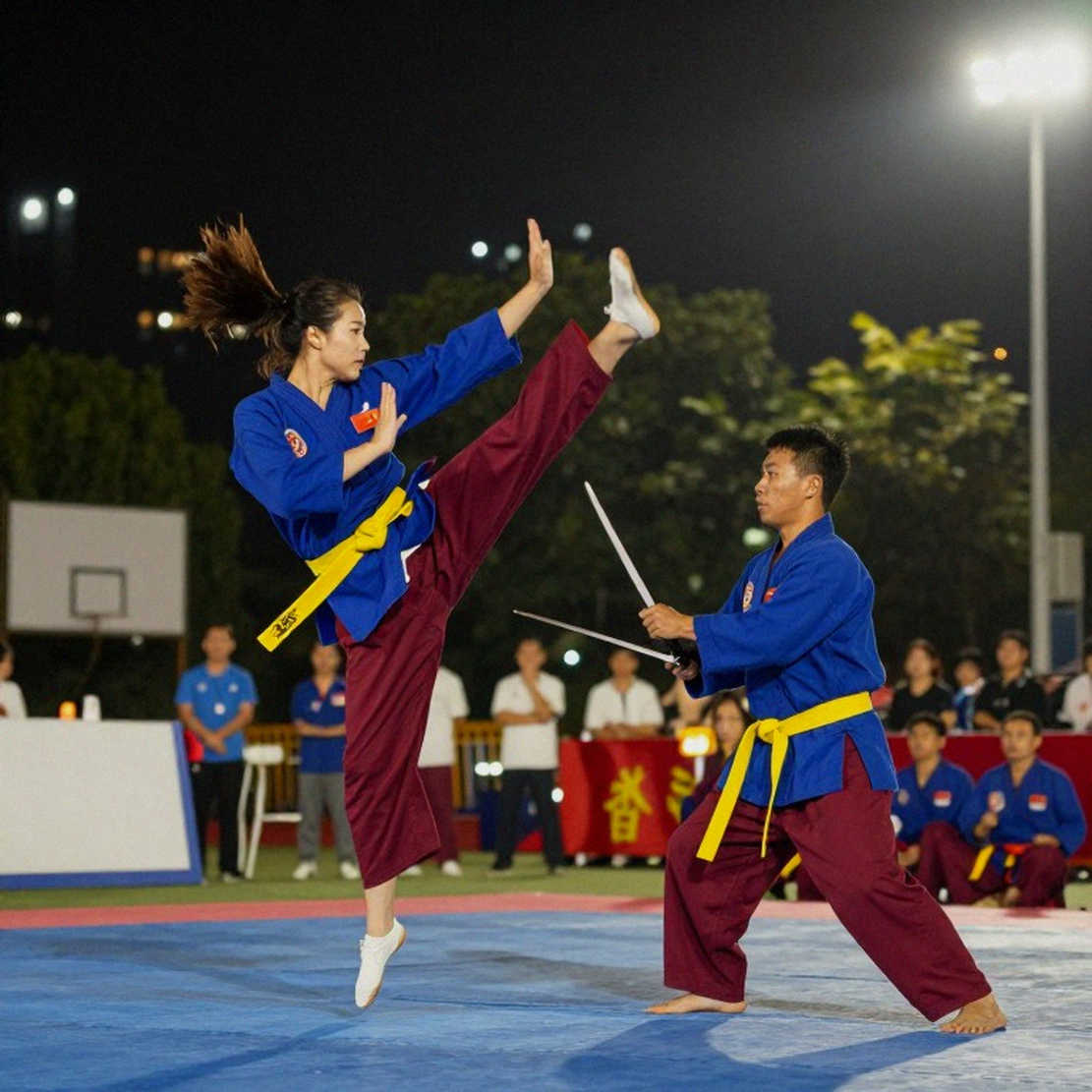
The question I ask myself is not whether Vietnam will win a medal. The question I ask myself is whether this program will be judged on what it is actually trying to build, or only on the number of medals hung around two athletes' necks on an October afternoon. Between those two ways of judging lies the distance between a sports nation that thinks long-term and one that only counts medals.
A 20-year-old steps into the lightest women's class, having just gone through a significant weight cut, just called the biggest hope of an entire team. She may achieve what no one dares guarantee. She may also learn a lesson every great athlete has learned, that failing on a big stage is part of becoming someone who can win on a bigger one.
The first lunge is never the fastest, but it teaches you how to keep your balance. This team is at exactly that moment: no longer newcomers, not yet at the finish. And how they keep their balance in that moment will say more than any medal about the future of Vietnamese taekwondo over the next decade.