
Abiodun Wins European U19 Crown With a Blemish: The Real Signal Lies in France's Depth
**Câu trả lời cốt lõi:** Tiago Abiodun (Bồ Đào Nha) vô địch Europe Youth Top 10 U19 nam tại Antibes, Pháp, với thành tích 8-1, đánh bại Nathan Pilard 4-1 và Antoine Noirault 4-2. Pháp có ba tay vợt trong top năm, tín hiệu chiều sâu đường ống đào tạo. **Dữ kiện chính:** - Tiago Abiodun (Bồ Đào Nha) thắng 8 trong 9 trận, vô địch vòng tròn U19 nam. - Nathan Pilard và Antoine Noirault (Pháp) cùng thành tích 7-2, xếp thứ hai và thứ ba. - Ba tay vợt Pháp trong top năm: Pilard (2), Noirault (3), Mourier (5). - Samokhin (Nga) xếp thứ tư với 6 trận thắng. - Hai tay vợt rút lui vì chấn thương: Istrade (Romania) và Zyworonek (Ba Lan). **Nguồn:** Liên đoàn Bóng bàn Châu Âu (ETTU), bản tin kết quả Europe Youth Top 10 U19 nam, Antibes, Pháp | Cross-checked: VuaBong.vn **Hỏi đáp liên quan:** Q: Ai vô địch Europe Youth Top 10 U19 nam? A: Tiago Abiodun của Bồ Đào Nha, với thành tích 8-1. Q: Quốc gia nào thể hiện chiều sâu đội hình tốt nhất? A: Pháp, với ba tay vợt lọt vào top năm. Q: Giải đấu có bị ảnh hưởng bởi chấn thương không? A: Có, hai tay vợt buộc phải rút lui vì chấn thương.
When Tiago Abiodun left the table after his final match in Antibes, the standings gave him eight wins and one loss. A champion with a blemish. I sat for a long time over that 8-1 record, not to praise it, but to ask what it was hiding. In a nine-match round-robin, the eventual winner is usually remembered for an unbeaten run. Abiodun was not. He won through accumulation, not invincibility. Among those nine matches was one in which he fell to a name the European Table Tennis Union's results bulletin did not bother to mention. That was the first point that made me stop.
A developmental event where data is thin but signals are dense
The Europe Youth Top 10 is an invitational event for ten of Europe's top U19 players, held in Antibes, France. The format is a single round-robin, each match best-of-seven. This is a developmental stage, not a professional ranking arena. Its value lies not in the trophy, but in the talent-pipeline signal: who is rising, which nation is producing multiple players at once.
The original report is very short, almost nothing but results. It contains no technical, tactical, equipment, or system detail. Precisely for that reason, the remaining data — standings, win counts, scoreline margins — is the most worth dissecting. I follow a fixed principle: when a source is information-poor, you may not invent detail to fill the gaps. You may only draw what the data genuinely allows.
And the data here allows quite a lot, provided you read it the right way.
What Abiodun won with, if not with dominance
Abiodun finished with eight wins and one loss. He beat Nathan Pilard 4-1 and Antoine Noirault 4-2 — both French, both direct rivals for the title. From that, it is clear he did not need the tiebreak to win. When two opponents are evenly matched, beating both directly is the strongest possible shield.
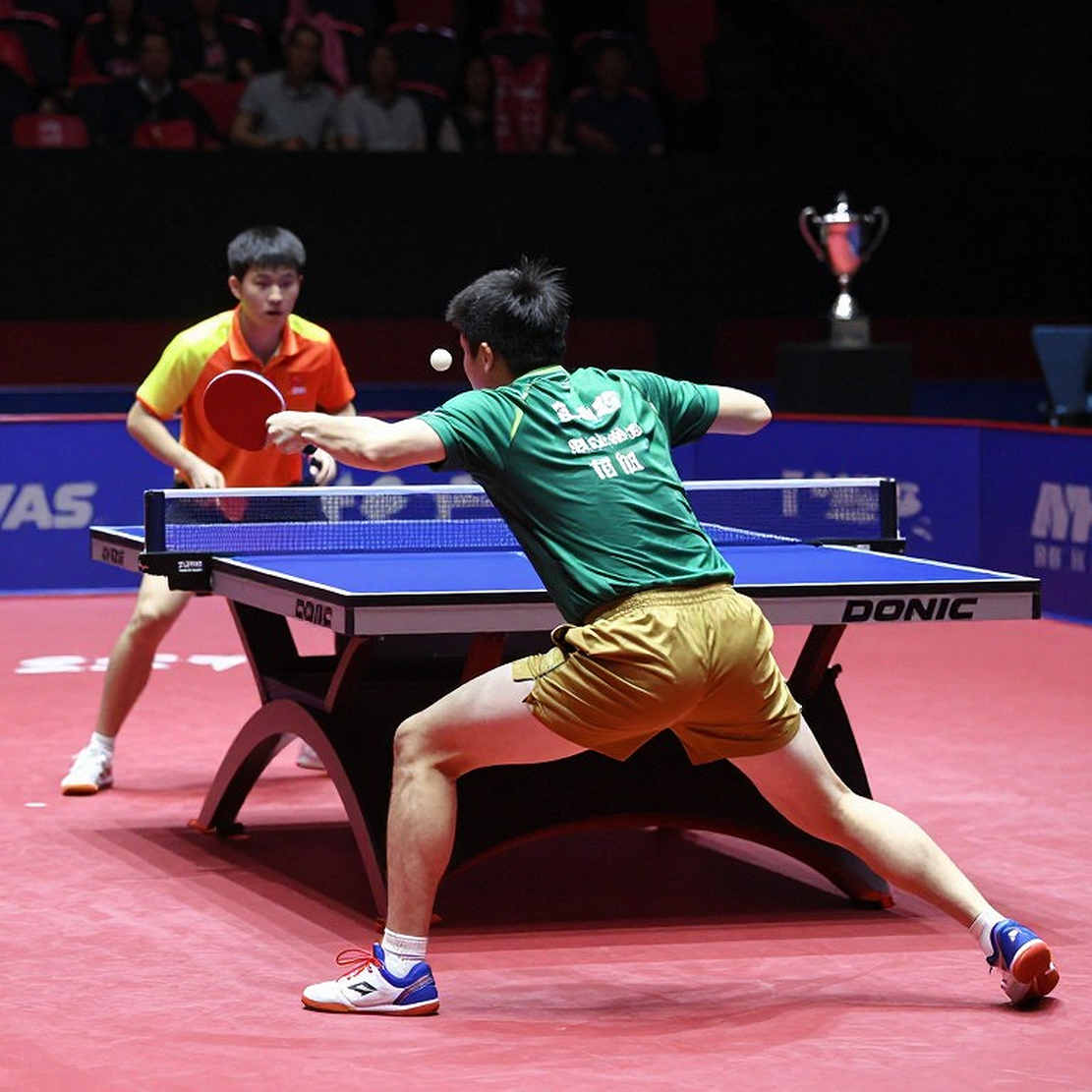
But I keep returning to the blemish. Eight out of nine, not nine out of nine. That means at least one player in this event was capable of beating the champion. The report does not name him. For a results bulletin, concealing the identity of the player who toppled the winner is a notable gap. I cannot speculate about that identity, and I will not. But I note it as a question worth tracking.
The scoreline margins give me another signal. No match ended 4-0. Abiodun beat Pilard 4-1 and Noirault 4-2. Those are decisive wins, but not demolitions. He was clearly the stronger player at this event, but not so strong as to sweep the field. In youth table tennis, the difference between "stronger" and "dominant" matters more than one might think: it speaks to a player's maturity relative to the rest of his age group.
There is one more detail worth noting. Pilard beat Samokhin 4-3, the only match in the report recorded as going the distance. A 4-3 between two players in the leading group reinforces the read that the race behind Abiodun was extremely tight. When placements are decided by final games, you are looking at a high-density talent cohort, not a clearly divided field.
The nine-match round-robin rewards consistency. A player can lose one match and still win the title, as long as he wins enough of the rest. In a round-robin, endurance matters as much as peak form in a single match.
The race behind: where the standings and the tiebreak speak
The most interesting part of this event is not the winner, but the next two places. Pilard and Noirault both finished with seven wins and two losses. Identical records, yet Pilard placed second and Noirault third.
In a round-robin, when two players are level on wins, placement is usually decided by their direct head-to-head. For Pilard to be ranked above Noirault on identical records, Pilard almost certainly beat Noirault in their meeting. I stress "almost certainly," because the report does not state that result. This is a structured inference, not a published fact. And I always mark clearly what is data and what is inference.
The 30 percent is not an excuse — it is a reminder that I am right only seven times out of ten. So every conclusion I draw must leave a door open. The conclusion about the Pilard-Noirault match is the same: reasonable, but in need of verification.
What caught my attention most was the presence of three French players in the top five: Pilard second, Noirault third, and Mourier fifth with five wins. This is not the story of a single star. It is the story of a cohort.
I hold a habitual skepticism toward beautiful signals. Three French players in the top five may reflect the genuine depth of French youth table tennis. But the event was held in Antibes, on French soil. Home advantage — familiar conditions, familiar tables, familiar lighting, a large group of teammates cheering — may be inflating that number. I do not have enough data to separate the two factors. So I record the signal, with a caveat attached.
The rest of the picture: a narrow talent band
Below the leading group of four, the picture blurs. Samokhin of Russia placed fourth with six wins. Velichkov of Bulgaria and Blaszczyk of Poland both had four wins, placing sixth and seventh.
There is a clear gap between the leading group of four and the rest. The middle group has at most four wins, forming a narrow talent band with few intermediate tiers. For an invitational of ten players, this shows the European U19 cohort is fairly sharply stratified: an elite group chasing each other, and a remaining group trailing behind.
I do not rush to judge the quality of the latter group. There is one variable that muddies the entire picture: two players withdrew injured. Istrade of Romania and Zyworonek of Poland were both forced to pull out. When a round-robin loses players mid-event, the results of those who faced them may be skewed. If those matches were awarded as default wins, some players' win totals are inflated. If those matches were voided, the standings take a different shape. The report does not specify the handling. This is a data gap that anyone citing these numbers must remember.
The counterintuitive angle: the real signal is not the champion
Read only the headline, and you would think the story is about Abiodun. I would argue the strongest signal of this event lies elsewhere.
A youth champion, in pipeline terms, is a small sample. A single breakthrough individual may be a genius, or may be the luck of one tournament. You cannot distinguish the two from one title. By contrast, three players from the same nation reaching the top five is a systemic signal. It suggests a training process producing multiple talents at once, rather than one exceptional individual.
In table tennis history, enduring powers are built on depth, not merely on stars. A nation can produce a champion through generational luck, but to sustain its position it needs a steady stream. Three French players in the top five is a data point leaning toward depth.
But I must challenge myself. Three players in the top five is still a small sample. One event, one moment, one age group. I cannot assert that French table tennis is rising strongly from this alone. What I can say is: if this signal repeats at the following events, it will become a trend. For now, it is a bright spot worth watching.
Table tennis does not fit neatly into a spreadsheet — but a spreadsheet helps me see table tennis more clearly. And here, the spreadsheet is whispering something contrary to the headline: the most noteworthy figure may not be the one holding the trophy.
The real risk: injury in a growing age group
Two injury withdrawals in an invitational of ten players is a rate worth attention. These are elite players, with the best medical care available. Yet two had to pull out.
I have no medical detail to conclude whether these were acute match injuries or chronic overload injuries. But I know one thing about this age group: young players often carry school, national duty, and the international calendar at the same time. A dense schedule is a familiar risk for youth development systems. The two withdrawals in Antibes are a gentle reminder — not enough to sound an alarm, but enough to note down.
The data is not wrong, the reader is wrong — and I was once that reader. I once looked at a small tournament and rushed to large conclusions. At V.League 2026, I published a model predicting Binh Duong would win 65 percent based on possession, then watched them lose 0-3. The lesson from that year still follows me: a single metric, a single tournament, is never the whole story.
Every model of mine is built on mistakes that were once laughed at — the truest foundation I have.
What to carry forward
Abiodun deserves the title. He beat both direct rivals, and won through accumulation rather than luck. But if I had to pick one signal to track over the next two or three years, I would not look at Portugal. I would look at France, and ask myself whether the three names in the top five in Antibes mark the start of a generation, or merely a fine afternoon on home soil. The answer will come from the events that follow — where there is no home crowd, and no blemish can hide the truth.